

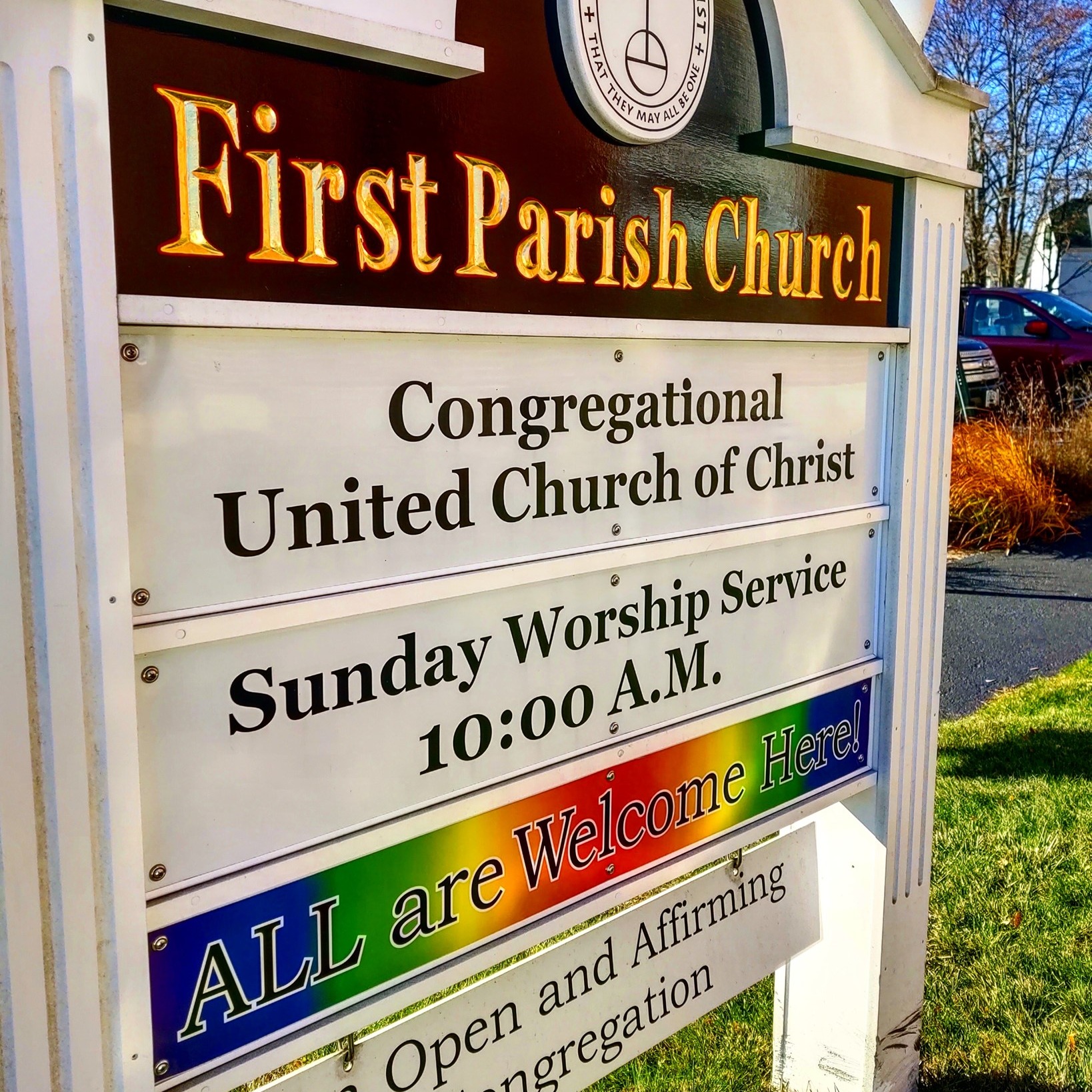
Free speech advocates are celebrating a win for religious expression after a judge threw out a criminal threatening case filed against a Somersworth man who posted a sign on a progressive church’s door.
The facts in the case were never in dispute.
A little before 4 a.m. on June 20 last year, Isaac Santiago, 50, posted a sign on the door of First Parish Church in Dover, a progressive congregation that prominently displays pro-LGBTQ images.
“Jesus is coming soon! The devil deceived you! God will never except [sic] LGBTQ. Be saved today, or you will perish in your sins! Repent and believe!” the sign read. Santiago didn’t attempt to enter the church, damage property, or confront any parishioners.
The dispute arose when prosecutors treated Santiago’s message as a criminal threat and attempted to have him convicted and jailed over what they said was a warning of spiritual consequences for pro-LGBTQ Christians.
On Tuesday, Strafford County Superior Court Judge Andrew Livernois granted a motion to dismiss the charges filed by Santiago’s attorneys.
“Assuming that the state were able to garner a conviction for criminal threatening in this case, it could not sustain a constitutional challenge under either the N.H. or United States Constitutions, because it would violate the defendant’s right to free speech,” Livernois wrote.
First Parish is a Congregational church that prides itself on its pro-LGBTQ community. Its ministers have performed same-sex marriage ceremonies for many years, and the church sign incorporates an LGBTQ rainbow. Santiago is a member of First Fruits Ministries in Manchester, which describes itself as a “first century Judeo-Christian Messianic congregation.”
“[Santiago] told the police that he viewed his actions as being part of his ‘ministry’; that God does not accept LGBTQ people, and that he was trying to spread that message, acknowledging that he may have gone about it in the wrong way,” Livernois wrote. “[Santiago] further told the investigators that he was not acting out of hate for anyone but did it ‘out of love’ and to share his religious convictions.”
While threatening speech can be prosecuted under the Constitution, Livernois ruled that Santiago’s short epistle, posted peacefully and late at night, did not rise to the level of an actual threat.
“The only portion of the sign which could arguably be viewed as threatening is the sentence that reads: ‘Be saved today or you will perish in your sins!’” Livernois wrote. “This could certainly suggest the idea of possible violence. But as [Santiago] points out, that language could also be interpreted as referring to the natural and inevitable death that every person will undergo.
“The ambiguity of the language undercuts the state’s position that the sign constituted a true threat. If it is a threat, it is quite vague and generalized.”
And, Liverois added, “except for certain narrow circumstances, the government cannot normally criminalize expressive conduct.”
Santiago was represented by Cornerstone Policy Research’s Ian Huyett, associate director and head of litigation, and attorney Rick Lehmann.
“It was a good day for free speech,” Lehmann said after the ruling.
Shannon McGinley, executive director of Cornerstone, said Livernois’s ruling protects all Christians who preach about sin and salvation.
“This case illustrates a serious risk: Because Santiago was charged solely for the content of his religious speech — and not for placing a sign on church property — allowing this prosecution to proceed would have left other Christians in New Hampshire vulnerable to criminal charges simply for warning others about hell and the judgment of God, even without any accompanying conduct,” McGinley said.
The case echoes the current legal dispute involving the Bow, N.H., school district, which banned parents from wearing pink wristbands with “XX” on them to protest a biological male playing on a high school girls’ soccer team. The district argued that it was the message, not the protest itself, that was “threatening,” and that parents were free to display pro-LGBT messages if they chose. U.S. District Court Judge Stephen McAuliffe affirmed that view in his ruling, which is being appealed.
Appeals court judges appeared dubious of that argument during a hearing in Boston earlier this month.
Andrew Manuse, lead pastor of First Fruits, hopes other Christians will take heart from Santiago’s court victory.
“I support Mr. Santiago’s message to First Parish Church in Dover, which was a loving call for errant leaders and members to turn away from their sins of affirming LGBTQ and repent to live in the righteousness and grace of Jesus Christ. More Christians need to stand firm in their faith as he has done.”