

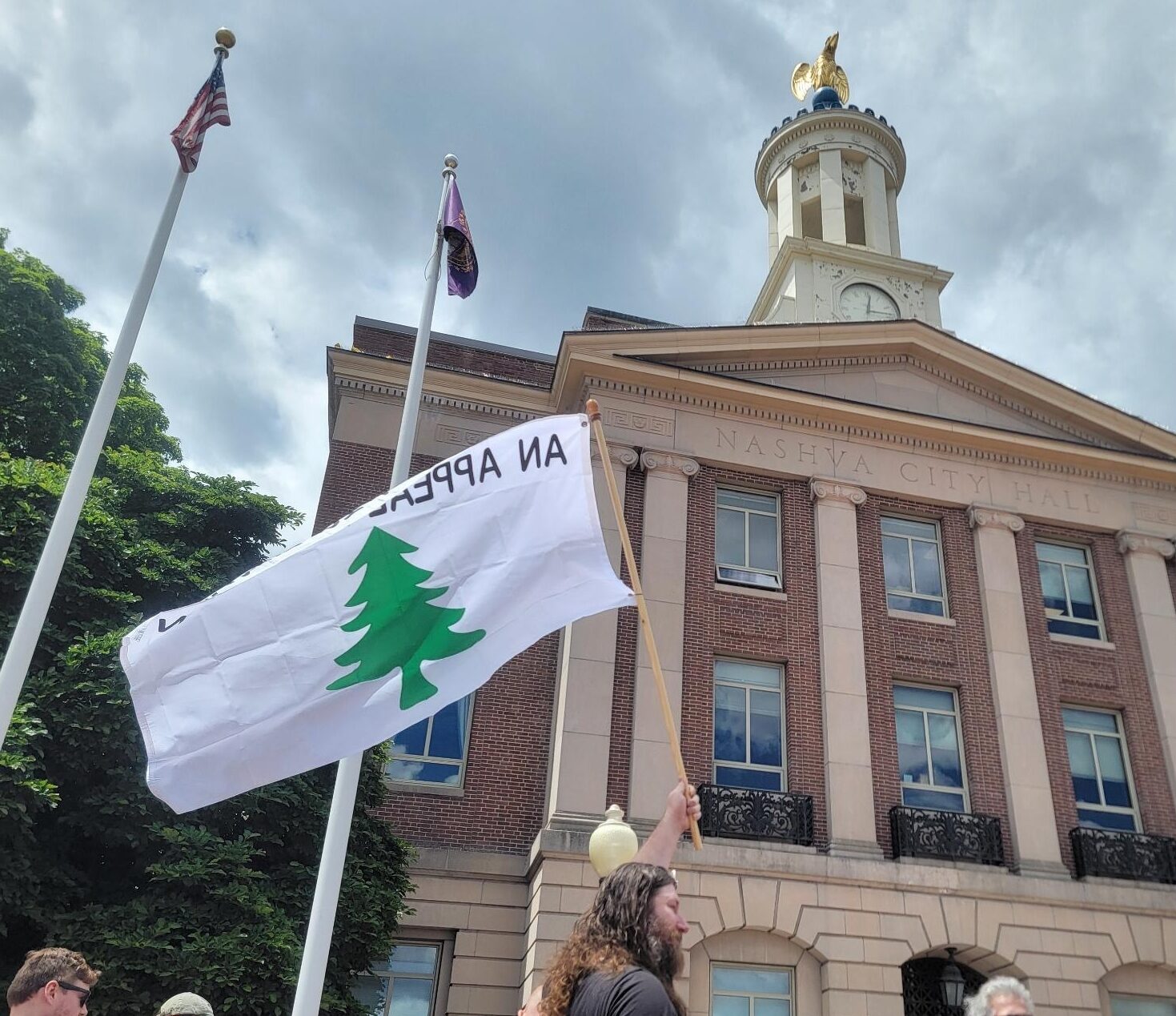
A federal court has formally declared the City of Nashua’s public flagpole policy unconstitutional, delivering a decisive defeat to city officials who argued they had the authority to block citizens’ flags and symbols that they found offensive.
On Feb. 2, the U.S. District Court for New Hampshire entered a declaratory judgment implementing a December ruling by the U.S. Court of Appeals for the First Circuit, finding Nashua engaged in “impermissible viewpoint discrimination” in violation of the First Amendment.
While the district court labeled its order “interim” for procedural reasons, the ruling leaves little ambiguity: Nashua’s flag policy — which allowed some private messages on a city hall flagpole while banning others — is unconstitutional.
“Any resumption of the City’s policy of during that time would be unconstitutional,” the court ruled. “Although the City cannot resume its prior practice or policy, the City of Nashua may close the Citizen Flag Pole to all private expression or return to the pre-2017 historic use of its flagpoles.”
The case, Scaer v. City of Nashua, was brought by longtime Nashua residents Stephen and Bethany Scaer, who were repeatedly denied permission to fly flags expressing viewpoints the city deemed objectionable, including the Pine Tree “Appeal to Heaven” flag, a “Save Women’s Sports” flag, and a “Detransitioner Awareness” flag.
In a unanimous opinion written by Sandra Lynch, joined by Judges Gustavo Gelpí and Jeffrey Howard, the First Circuit rejected Nashua’s claim that the so-called “Citizen Flag Pole” represented government speech.
Instead, the court found the program operated as a forum for private expression — one that the city could not selectively police based on viewpoint.
“For years, Nashua allowed a rotating array of private flags conveying different and sometimes dissonant messages,” the court wrote, noting that the city exercised little control over the content or presentation of the flags until complaints arose. The court compared Nashua’s actions to a “classic heckler’s veto,” where speech is suppressed in response to public opposition rather than neutral rules.
“We’re grateful that the court has formally ruled that the city’s flag program was unfair and unconstitutional,” resident Beth Scaer told NHJournal. “This case was always about equal treatment—about being able to participate in a public forum the same as everyone else, without being censored by the government. We’re happy that our First Amendment rights have been vindicated.”
During oral arguments before the First Circuit Court justices, Nashua Corporate Counsel Steve Bolton said the city has the right to block “unsavory” messages conveyed by private citizens.
“It’s right in front of city hall. It’s right on Main Street, passers by will say, ‘There’s city hall, look. What kind of a place is Nashua if they’re flying this symbol, or that symbol, or some other symbol that is generally not regarded as savory,” Bolton said.
Attorney Nathan Ristuccia, who litigated the case for the Institute for Free Speech, said the ruling sends a clear message.
“Governments may not open a forum for public participation and then decide which messages are acceptable,” Ristuccia said. “The court has now definitively ruled that Nashua cannot administer its flag program in a way that favors some viewpoints over others.”
The ruling is yet another black eye for United States District Court Judge Landya McCafferty, who sided with the City of Nashua in the original case and saw her ruling overturned. McCafferty, an Obama appointee, is known for her progressive jurisprudence.
Meanwhile, Nashua is already moving forward with a new flagpole ordinance declaring the flagpoles “exclusively controlled by city government” and “disavowing” the term “citizen flagpole.”
“To the extent any such flagpole has ever been a public forum or a limited public forum, the forum is closed,” the proposed ordinance reads.