
inside sources print logo
Get up to date New Hampshire news in your inbox

Four Years Ago, Biden and NHDems Promised to Fix This Bridge. It’s Still Closed.

Four years ago this week, Tom Brady was the starting quarterback for the Tampa Bay Buccaneers, Cleveland’s baseball team was still called the Indians, and the Green Bridge in Woodstock was a rusted-out, rickety danger.

Today, Brady is no longer playing ball, the Indians are now the Cleveland Guardians, and the Green Bridge is still a rusted-out, rickety danger.

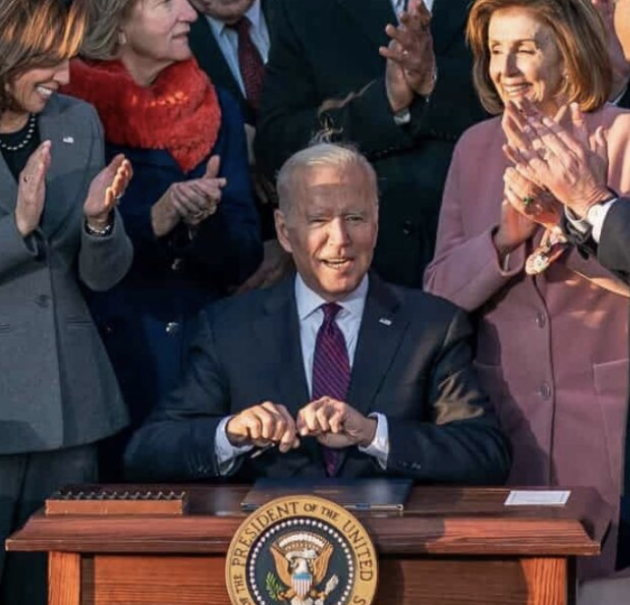
On Nov. 16, 2021, President Joe Biden and New Hampshire’s all-Democrat delegation walked out onto that bridge to tout their $1 trillion Infrastructure Investment and Jobs Act, promising the spending bill would finally fix the 86-year-old span across the Pemigewasset River.

“America is moving again, and your life is going to change for the better,” Biden said at the time.

But not moving very fast. According to Woodstock Public Works Director Mike Welch, the bridge won’t be completed anytime soon. In fact, as residents in the White Mountains resort town head to work on Monday, the bridge is expected to be completely closed to traffic.

The Green Bridge in Woodstock, N.H., November 2025
(CREDIT: Damien Fisher)

Months of work to strip old paint from the steel bridge and apply new coats are finally done, and the long-awaited structural repairs will begin. Steel cables need to be replaced, and the bridge deck must be lifted and rebuilt. Welch claims the project — managed by the state with state and federal funds — is surprisingly on target despite a four-year wait.

New Hampshire has listed the Green Bridge as unsafe since 2014. Despite Biden’s promises to boost the economy with increased infrastructure spending, the renovation has moved at the usual pace.

“I don’t know that it’s way behind,” Welch said.

Using nearly 100-year-old technology, the Empire State Building was built in less than 14 months. After Hurricane Ian cut off Sanibel Island from the Florida mainland, Gov. Ron DeSantis (R-Fla.) got emergency road and bridge repairs done in three days.

But four years after Sens. Maggie Hassan and Jeanne Shaheen stood on the Green Bridge, drivers are still restricted to one lane as the deck continues to deteriorate. The bridge’s current three-ton maximum vehicle capacity — imposed due to its poor condition — is well below the average weight of many full-sized SUVs.

The Green Bridge in Woodstock, N.H. November 2025.
(CREDIT: Damien Fisher)

And the contract completion date for the bridge is November 6, 2026 — almost another year away.

Now, people living on the other side of the river on Route 175 will need to detour miles out of their way to go about their normal routines. Welch said the inconvenience won’t affect many people. The 175-foot bridge typically carries about 570 cars a day.

“It’s not a high-volume road,” Welch said.

Kim Pickering, executive director of the Western White Mountains Chamber of Commerce, said most locals are already accustomed to getting around without the bridge.

“We’re New Englanders — we’re pretty adaptable,” Pickering said. “We’ve all gotten used to the limited access.”

Woodstock residents already deal with traffic surges during tourist season, Pickering said. Adding a detour for a largely residential area won’t disrupt business in town.

People who live on the other side of the river can get to nearby Lincoln to access I-93 or drive a few miles south to connect with Route 3. But the detour affects more than commuters.

Driving around the closed bridge is a mild inconvenience for an oil truck, school bus, or UPS delivery — but it’s a serious concern for fire trucks and ambulances, potentially losing minutes on their way to an emergency. The North Woodstock Fire Station is about a third of a mile from the Green Bridge and four miles from the next crossing over the river.

Since the Green Bridge became part of Biden’s spending agenda, he has lost his bid for reelection, Brady has gotten a facelift and become a broadcaster, and the Guardians have managed to put together three winning seasons out of four.

Strafford County Chair Now Claims Low Bid Unworkable

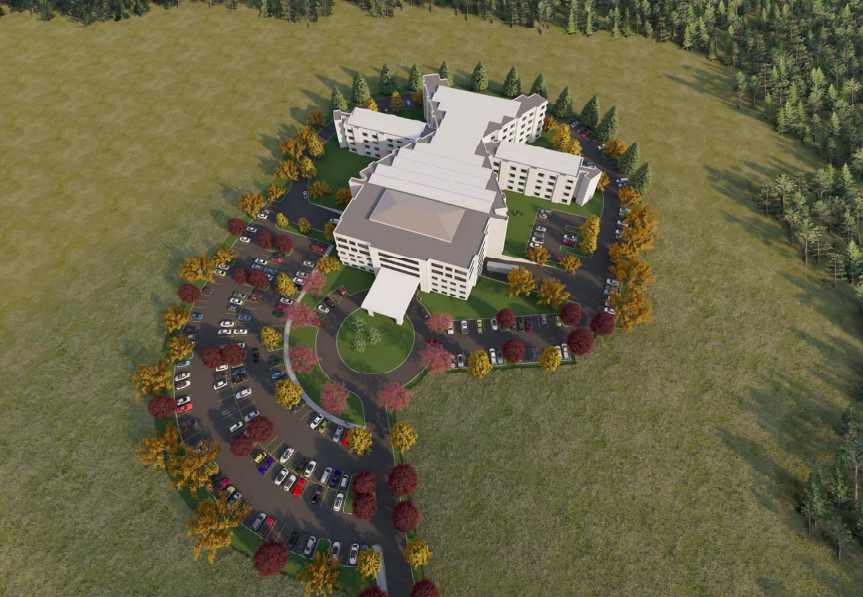
After taking heat for picking the $180 million design for the proposed new Strafford County Nursing Home over a $50 million bid, and then saying he never saw the less expensive bid, Commissioner George Maglaras said Wednesday the low bid wasn’tould work.

“The commission picked the firm we thought had a track record of building larger nursing homes and there are other written responses required within the answering of the RFP,” Maglaras told NHJournal.

Republican members of the Strafford County Delegation blasted Maglaras, a Democrat, and the two other Democratic Commissioners this week after learning about the lower bid from EGA Architects. Rep. Cliff Newton said the Commission kept him and other delegates in the dark about the lower-cost bid on the 215-bed proposal.

“Strafford County Commissioners and administration never informed the delegation of the EGA’s lower cost plan. Instead, they chose a much more expensive and institutionalized building plan without exploring different options that would have been acceptable to the entire delegation,” Newton said.

When contacted Tuesday about the EGA bid, Maglaras initially told The Rochester Voice he never saw EGA’s bid. That’s despite the fact the NHJournal found records showing the Commission was presented with all six bids, including EGA’s, on the project in 2022 when they voted to go with Warrenstreet. By Wednesday, Maglaras blamed politics for the kerfuffle, and said he was misunderstood.

“I said that there was never a $40 million proposal put before us,” Maglaras said. “These claims by some of the Republican members are misguided and are inflammatory and political in nature.”

According to Maglaras, the EGA bid quoted the Commission a cost of $350 a square foot to build the new home. But that number was never going to work, he said. EGA cited its work building the Carroll County Nursing Homes 10 years ago in its bid to Strafford. However, the construction company hired by EGA in Carroll told a slightly different story, Maglaras said.

“I brought in Bonnette, Page and Stone who was the contractor that actually built the Carroll County Nursing Home designed by EGA and they told the entire delegation in a public meeting it would cost $600 a square foot to construct a similar facility today and that the (Carroll County) home does not meet present federal design standards,” Maglaras said. “Architects don’t build buildings, construction companies do. You need to compare apples to apples not apples to cherries.

Comparing Maglaras’ math, that means the EGA bid would have cost as much as $83 million at $600 per square foot, instead of the $50 million the company quoted. The Warrentstreet project costs close to $1,300 per square foot.

The Republicans on the delegation have twice blocked the Commission from getting bonds for the $180 million proposal, and the Nursing Home project is currently stalled out. Maglaras wants to see the project get back on track.

“We have offered to meet with all the parties to see if we can’t move the process forward. The offer still stands and we will be reaching out to them,” Maglaras said.

REPORT: Granite State’s Economy Fifth Best in Nation

New Hampshire has one of the strongest state economies in the country, with high rates of high-tech jobs, low unemployment, and a GDP growth rate that outperforms California, according to a new data analysis from WalletHub. 

The report, which looked at how each state’s economy has fared since the end of the COVID-19 pandemic recession, ranks the Granite State as the fifth-best economy in America, behind Washington state, Utah, California, and Massachusetts.

New Hampshire easily outperforms the remaining New England states, with Connecticut coming in at 25, Rhode Island at 36, Vermont at 41, and Maine trailing at number 44.

However, according to experts, New Hampshire could be headed toward a recession as runaway inflation continues to drive up the price of energy, housing, and other needs.

New Hampshire comes in second, behind Tennessee and ahead of California, when it comes to positive change in gross domestic product or GDP. It is tied for first with Utah, Nebraska, Kansas, and Minnesota for the lowest unemployment rate. It is fifth when it comes to having the highest number of immigrants with advanced educations, and is fourth in the percentage of high-tech jobs.

Gov. Chris Sununu said the overall picture is good, but warned there are negative forces outside New Hampshire’s control that could be a problem.

“We’ve taken steps over these last few years to ensure that New Hampshire’s economy remains strong,” Sununu said. “But given Washington’s inaction in combating inflation and out-of-control spending, an economic downturn is on the horizon, and we are doing everything we can at the state level to minimize the impact on our citizens.” 

One expert interviewed by WalletHub, Robert Wyllie, Assistant Professor of Political Science ad Director of Political Economy Program at Ashland University in Ohio, said the country as a whole should be concerned about a potential recession and inflation getting worse. He said we could see a return to the 1970s.

“High inflation, fueled in part by high energy prices, combined with slow growth points has drawn many comparisons to the 1970s,” Wyllie said.

A recent University of New Hampshire Carsey School of Public Policy report warned of a stagnating economy. New Hampshire’s economy needs state and federal leaders to address roadblocks that come up as the world economy tries to move past COVID.

“As the state, nation, and world hopefully emerge from the COVID-19 pandemic and the economic carnage it created, New Hampshire is, to some extent, subject to economic forces beyond its control,” the report states.

The state’s many long-term challenges include the housing shortage, the shrinking labor force, the need for childcare, and infrastructure investments.

“New Hampshire has many economic advantages that position it well as it seeks to address the challenges of wage stagnation, childcare shortages, educational inequity, an aging workforce, housing affordability, struggling families, and C- infrastructure,” the UNH report states. “It has a strong and diverse economic base from which to grow, and its workforce is well-educated. With foresight and will, New Hampshire can chart a course to a productive, prosperous economy that addresses these challenges and enhances the well-being of all who live here.”

However, New Hampshire has also repeatedly been ranked near the top of the “Freedom Index” by multiple sources, due to its low tax and low regulation environment. And that could be both a reason its economy is overperforming today and has a brighter future tomorrow.

In the Wallethub report, Vincent Gloss, assistant professor of economics at George Mason University argued that “economic freedom (i.e. lower regulation, lower taxes and lower spending, safer property rights) does not only minimize downturns associated with exogenous shocks such as a pandemic, but it also accelerates recovery. Governments should look at policies that allow firms and families more flexibility in their decisions and that means stepping back.”

New Hampshire’s Delegation Celebrates Signing of Biden’s $1.2 Trillion Infrastructure Bill

U.S. Rep. Annie Kuster stood in the White House Rose Garden Monday moments before President Joe Biden was due to sign the $1.2 trillion infrastructure spending, celebrating the spending.

“A billion dollars coming to New Hampshire for roads and bridges and highways, we’re even going to get rail back to New Hampshire,” Kuster said in a video posted to Twitter.

As Kuster spoke, the United States Marine Corps Band played “76 Trombones” from the Broadway show, “The Music Man,” about a con artist who made big promises he couldn’t keep.

Kuster and the rest of New Hampshire’s congressional delegation celebrated Biden’s signing of the bill, citing the investments in roads and bridges, as well as broadband internet for rural areas like New Hampshire, public transportation expansion, and investments in clean drinking water.

“This bill has so many elements that will be game-changers for our families and our economy,” said Sen. Maggie Hassan.

Hassan is facing a potentially tough reelection bid despite presumed front-runner Gov. Chris Sununu bowing out of the race last week. Polls show Biden’s spending package is popular, even if the president himself is not.

Rep. Chris Pappas, whose congressional career faces possible extinction thanks to Republican-led redistricting, also supported the spending plan.

“I’m pleased the president has signed this legislation into law, and I look forward to beginning the work of repairing our infrastructure,” he said.

Both Pappas and Kuster’s poll ratings dipped into negative territory in the latest New Hampshire Institute of Politics poll, a first for both of them. Pappas was at 42 percent favorable to 46 percent unfavorable, Kuster landed at 40 percent to 46 percent.

The only Democrat not facing reelection this year, Sen. Janne Shaheen, touted her role in crafting the spending legislation.

“As a lead negotiator, I fought to ensure New Hampshire priorities were front and center: that includes investments to upgrade our water infrastructure – including robust support to combat PFAS contamination – and to bring high-speed internet to every corner of our state,” she said.

Backing the nominally bipartisan infrastructure plan, which had 13 Republican House votes, is risky for the three incumbents facing voters next year. Biden is underwater with Granite State voters, according to the most recent polling data. His recent polling average is 42 percent approve/52 percent disapprove. As Gallup reports, “Currently, 34 percent of independents approve of the job Biden is doing, the lowest of his term to date. His approval among independents has fallen a total of 21 points since June, including nine points since August.”

Biden is also trying to push through his $1.75 trillion Build Back Better social safety net spending package that includes spending on daycare, cash payments to parents, and green energy policies. Given a 30 percent spike in inflation, a majority of New Hampshire voters may not want to see all of that spending. Only 37 percent of Granite Staters want the “Build Back Better” multi-trillion-dollar spending package to pass, while 40 percent would like to see both spending bills killed, according to the polls.

And a Scott Rasmussen poll taken in August, before inflation become a top-tier issue, found 59 percent of voters nationwide believe increased government spending leads to inflation. Only 14 percent disagreed.