
inside sources print logo
Get up to date New Hampshire news in your inbox

Trump Hating Sign Stomper Loses Right to Vote

The state of New Hampshire has stripped an anti-Trump Northfield man of his right to vote after he pleaded guilty to kicking Trump campaign signs. Now, some are asking if the punishment exceeds the crime.

Nick Coots-Moorehead, 55, pleaded guilty this week to one Class B misdemeanor count of unlawfully removing political signs during the 2024 election cycle. He could not be reached for comment; his publicly listed phone number is disconnected.

Coots-Moorehead walked into the yard of a Northfield couple three times last year to kick their Trump sign and yank it out of the ground, according to court records. The couple managed to catch Coots-Moorehead’s actions on video, which they shared with Northfield police and investigators with the New Hampshire Attorney General’s Election Law Unit.

In the video of the final incident, Coots-Moorehead is seen kicking the sign down and then giving the homeowner the middle finger after she yelled at him, according to the police report. Coots-Moorehead initially claimed the signs were on the public sidewalk and in his way as he walked past the house. But the videos told a different story.

Coots-Moorehead won’t spend any time in jail, but he will pay $310 in fines and court fees, along with the revocation of his right to vote. Losing voting rights for a misdemeanor may seem extreme, but it is not an unusual consequence in New Hampshire for anyone who breaks election-related laws.

Article 11 of the New Hampshire Constitution states that the right to vote will be removed if a person is “convicted of treason, bribery, or any willful violation of the election laws of this state or of the United States.” Coots-Moorehead was prosecuted under election laws meant to protect political speech.

Last year, former Republican state Rep. Troy Merner had his right to vote taken away for two wrongful voting convictions. The Lancaster state representative moved to nearby Carroll before the 2022 election but stayed on the ballot and was reelected to represent Lancaster. Despite an investigation by the Attorney General’s Office into his living situation, Merner claimed he was still legally domiciled in Lancaster when he voted in the 2023 Lancaster municipal election.

Stripping voting rights from convicted criminals, regardless of the crime, has become a contentious issue in American politics. About half the states allow convicted criminals to vote as soon as they leave prison. Others require felons to complete their entire sentence, including probation. Progressive organizations want more states to automatically “re-enfranchise” felons after they’ve served their time.

Two states, Maine and Vermont, never take away a convicted criminal’s right to vote, allowing them to participate in elections while incarcerated.

The good news for Coots-Moorehead and Merner is that the state constitution allows people whose voting rights have been revoked to seek restoration from the state Supreme Court. The bad news is that the one justice who might understand their plight, Associate Justice Anna Barbara Hantz-Marconi, is recusing herself from criminal cases.

Hantz-Marconi pleaded no contest this month to a Class B misdemeanor charge alleging that she tried to get Gov. Chris Sununu to look at a pending criminal investigation into her husband, former Ports Director Geno Marconi. Hantz-Marconi paid a $1,200 fine as a result of the conviction, but had her law license restored and returned to the court a week later.

School Funding Ruling Could Kill NH Advantage, Group Warns

New Hampshire could see economic growth grind to a halt, tax rates explode, and the state government take control of local schools if the state Supreme Court upholds the rulings in the Rand and ConVal education funding cases.

That’s the scenario laid out by free-market think tank American Institute for Economic Research in its amicus brief filed in court this week.

The state is appealing the Superior Court rulings in the Rand and ConVal lawsuits which, if enforced, upend the current school funding system by bringing back so-called donor towns and adding more than $500 million of taxpayer money to the state adequacy grant system.

AIER Senior Research Fellow Jason Sorens told NHJournal school funding isn’t about left or right politics, but about avoiding negative consequences like ballooning taxes, anti-business and growth measures, and the loss of local control. 

“Should we encourage towns to have low property values? Should we punish towns for choosing to allow apartments or commercial development?” Sorens said.

Last year, Rockingham Superior Court Judge David Ruoff ruled in the Rand v. New Hampshire lawsuit the state’s Statewide Education Property Tax system is unjust since it allows communities with high property values to keep excess SWEPT funds, essentially paying an unequal tax rate than communities with lower property values.

Then in the ConVal v. New Hampshire case, Ruoff ruled in favor of the coalition of school districts led by the Contoocook Valley School District that argued the state is violating the constitution by failing to fund an adequate education. Ruoff ruled the state’s per-pupil adequacy grants need to go up from $4,100 per pupil to at least $7,300.

Sorens and AIER President William Ruger said they want New Hampshire to keep its current system and find other ways to fix education without restrictive government action or more taxes.

“School finance equalization has been a big driver of new taxes and unnecessary government growth across the country,” Ruger said. “AIER’s economic analysis shows that it has mostly been based on misconceptions about the alleged ‘inequity’ of locally funded education. With this case, we hope the Court will set a new precedent, based on sound economic reasoning, that vindicates local control of school funding and decentralized competition among governments.”

The old donor town system of transferring tax dollars from property-rich towns to property-poor communities will return if Rand is upheld, Sorens said. That system brings economic stagnation and real inequality.

Asked if he would describe the donor town system as a “progressive property tax,” Sorens said it’s worse.

“It’s punishing whole towns for having high property valuations, not individuals,” Sorens said.

Advocates for a state school system funded by handouts from so-called “wealthy” towns need to check their math, Sorens said. He pointed out the proposed plan would see people in Lebanon subsidizing education in communities like Brookline, despite the latter having one of the highest median incomes in the state. Meanwhile, Lebanon has one of the highest child poverty rates, Sorens said.

“It redistributes income from poor people to rich people,” Sorens said.

The Rand decision ignores the fact towns that encourage business, commercial enterprise, and housing tend to have higher property valuations. If donor towns come back, New Hampshire will see municipalities in an arms race to kill business, discourage building more housing, and drive out innovation with restrictive zoning laws, Sorens said.

“It incentivizes towns not to grow their property tax base,” Sorens said.

With ConVal, Sorens said nearly every school district in the state can already afford to fund an adequate education without the state adequacy grant. Instead, New Hampshire should give parents more options like more charter schools, more Education Freedom Accounts, and open enrollment for all public schools, Sorens said.

Vermont’s misguided attempt to fund its education system should serve as a warning to New Hampshire, according to Sorens. The 1997 Act 60 plan to pool all education property taxes in Vermont and send that funding to each district has resulted in a restrictive government that punishes communities for spending more on education money than poorer communities. Vermont has also taken away control of the education system from local boards and forces consolidation into large, regional districts.

“The state gets deeply involved in local budgeting and administration,” Sorens said. “We doubt many New Hampshire residents would be happy with their towns being forced to join these big regional school districts.”

Sorens may be familiar to Granite Staters as the man behind the Free State Project. He is credited with coming up with the plan to have libertarians move to New Hampshire in 2001 in order to enact a libertarian agenda. 


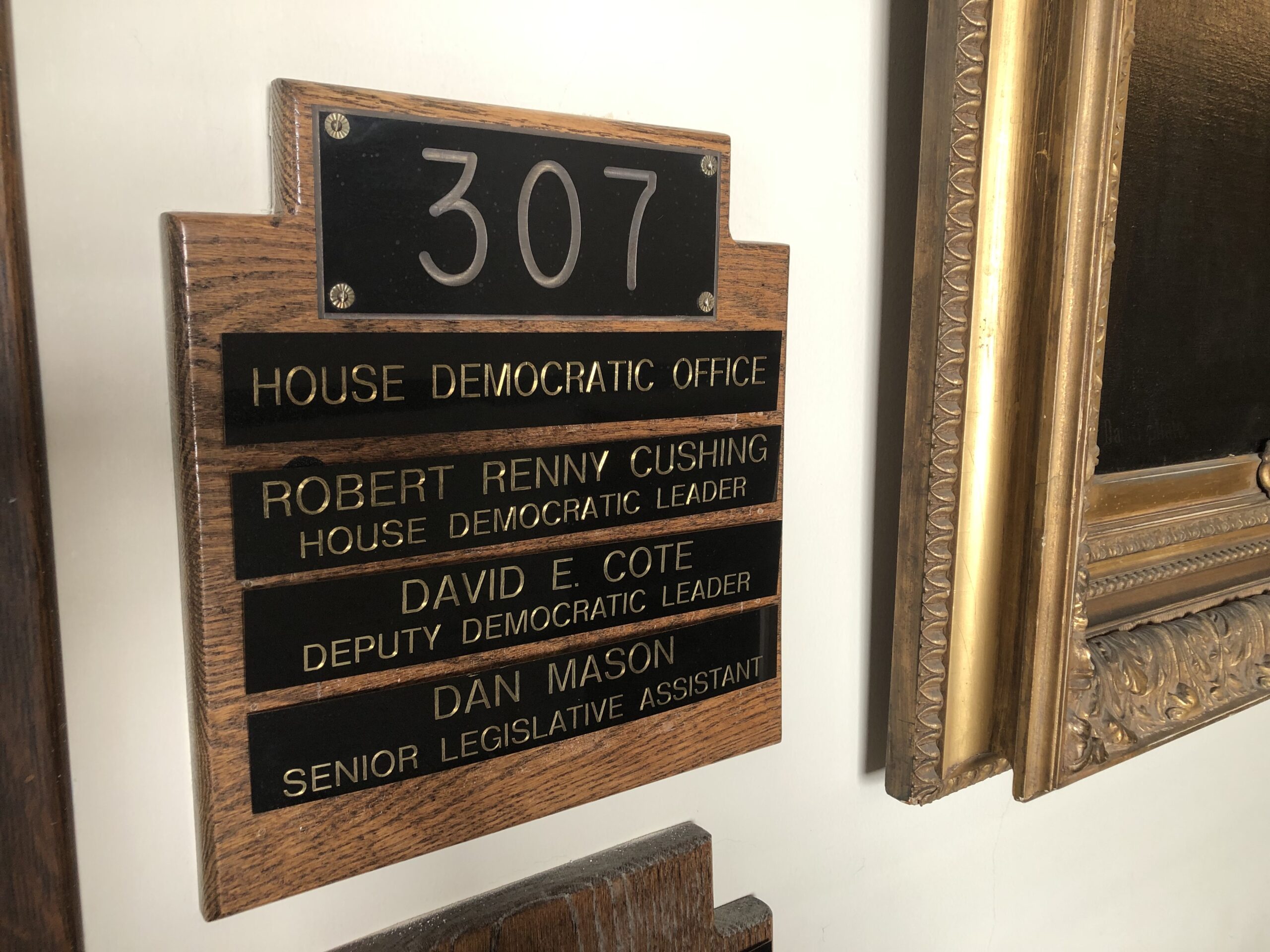
With Cushing’s Passing, Who Will Lead House Dem Caucus?

CONCORD — New Hampshire Democrats face a difficult dilemma in the wake of the death of House Minority Leader Renny Cushing: Fight or flight?

Do Democrats hold a vote to pick a new leader, which would almost certainly lead to a divisive leadership fight; or do they stick with acting Minority Leader Rep. David Cote (D-Nashua) and ride out the rest of the session?

What most voters probably don’t realize is that by state law, Democrats do not get to pick their leader. Under New Hampshire’s Constitution, the authority to name the leaders for both parties rests not with the party caucuses, but with Speaker of the House Sherman Packard (R-Londonderry).

“Technically, it’s up to the Speaker,” said Secretary of State David Scanlan. “But how we get there is up to the Democrats.”

Democrats can vote for a leader, but the choice has to go through the Speaker of the House. 

“The minority caucus has to determine what they are going to do,” said Clerk of the House Paul Smith. “But there’s nothing in the rules that [says] the Speaker has to name anyone to anything.”

When Republicans lost their leader, Rep. Dick Hinch, to a COVID-related illness just over a year ago, they didn’t face this situation because he was Speaker. The position is elected by the entire House and there are clear rules in the Constitution and state law about picking a replacement.

“Within 30 days after a vacancy occurs in the office of president of the Senate or speaker of the House of Representatives, the Senate or House of Representatives, as the case may be, shall select a successor from among its members.”

Smith said when there has been a death of a party’s leader in the past, the party has chosen to keep the acting leader in place for the remainder of the session. Given there are just a couple of months left in the current legislative session, Smith said Democrats could keep Cote in place for the time being.

Packard was not available for comment on Tuesday, and Cote did not respond to a request for comment. 

Former House Speaker Shawn Jasper said he could not recall any past Speaker ignoring the wishes of either party when it comes to picking leadership.

“(The Speakers)  just can’t do that on their own,” he said.

While Democrats could keep Cote in place, Jasper said, much legislative work remains to be done in Concord and the party might want to hold a leadership vote.

“What complicates the matter here is that (Cote) has not been coming to the State House. It will be very difficult for him to be effective for the next couple of months. He needs to be on-site,” Jasper said.

According to multiple sources inside the Democratic caucus, Cote is “terrified of COVID,” and as a result has refused to attend any in-person gatherings.

“You can’t run the caucus from your basement,” one concerned Democrat told NHJournal.

Greg Moore, who served as the chief of staff for the New Hampshire House of Representatives, said it has been a difficult couple of years, with both parties losing their leaders.

“It’s been a tough legislative session for the House,” Moore said.

Moore thinks Democrats are likely to hold a leadership vote in the coming weeks. Cushing was well-liked on both sides of the aisle, and he had the ability to lead. That is something Democrats will miss.

“When you lose your leader, you want to have somebody who has the force of the vote,” Moore said. “That gives the caucus a lot of confidence.”

If there is a caucus in the coming weeks, Moore said the candidates who ran against Cushing last time are likely to be top contenders. Rep. Matt Wilhelm (D-Manchester) and Rep. Marjorie Smith (D-Durham), who both challenged Cushing for the Minority Leader post, did not respond to requests for comment.

Moore said the ultimate decision will be made by the members.

“It’s up to the caucus what they want to do,” Moore said.