
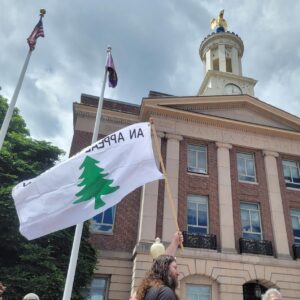
For the second time in a month, New Hampshire liberals will be forced to defend their restrictions on speech and expression before a federal appeals court in Boston. And if history is any guide, they will find themselves facing an uphill fight.
In November, it was the Bow, N.H., school district attempting to explain why banning speech about transgender issues it found hurtful was okay, even as it allowed affirming speech on the same topic. At one point the school district’s attorney compared free speech to “poison.”
The court did not appear impressed.
On Tuesday, that same federal appeals court will hear arguments in a closely watched free-speech case involving Nashua’s decision to reject a Pine Tree Flag application for its “Citizen Flag Pole,” a move free speech advocates say amounted to unconstitutional viewpoint discrimination.

At issue is whether Nashua city officials can decide which citizen-requested flags are “worthy” of being flown on the public pole — and whether city officials effectively shut down a public forum rather than allow symbols they didn’t like.
The lawsuit was filed by Nashua residents Bethany and Stephen Scaer after the city denied their request to fly the historic Pine Tree Flag to commemorate the Battle of Bunker Hill. Municipal officials rejected the application, saying the flag was “not in harmony” with Nashua’s preferred message.
The Scaers say that phrase — “in harmony” — is the problem.
For years, Nashua allowed residents to apply to fly flags on a designated “Citizen Flag Pole” outside City Hall. But after the U.S. Supreme Court’s 2022 decision in Shurtleff v. City of Boston, which limited government attempts to restrict citizen-sponsored flags, Nashua rewrote its policy to assert greater control.
Under the new rules, flags would be approved “only if in harmony with city policies and messages that the city wishes to express and endorse.” The city defended that position in a letter to the Scaer’s attorney.
“It is the City’s position that the proper approach is to view the use of the flag pole as ‘government speech’ where the City has reserved the right to determine the message that will be attributed to it.”
The Scaers argue that language lets officials reject any viewpoint they find politically inconvenient, turning what had functioned as a public forum into tightly curated government speech.
The Institute for Free Speech, which is representing the Scaers, says Nashua’s new process violates the First Amendment by giving the government “unbridled discretion” to decide which citizens’ messages are acceptable.
Free-speech advocates say the case highlights a growing problem nationwide: local governments trying to sidestep constitutional protections by declaring that public spaces used for citizen expression are actually government speech.
The Supreme Court warned against that tactic in Shurtleff, noting that cities cannot convert a public forum “into government speech by fiat” simply to avoid hosting viewpoints they dislike. The Scaers argue Nashua did exactly that — and did so because citizens began requesting flags the city didn’t politically support.
Nashua officials have previously prevailed at the district-court level, where liberal Judge Landya McCafferty upheld the city’s argument that the flagpole is government-controlled expression. But the appeal has drawn significant attention from civil-liberties groups that say if McCafferty’s ruling stands, it could let cities across the region eliminate public speech forums at will.
The First Circuit will hear the case at 9:30 a.m. Tuesday at the Moakley Federal Courthouse in Boston. The Scaer case is the second argument scheduled for the morning session. The court will also stream the proceedings online.
For the Scaers, the issue remains simple: if a city invites residents to share messages on a public flagpole, it should not be able to silence viewpoints it finds politically out of step.
“This case is about whether the First Amendment still protects citizens from government censorship,” their attorneys say.
One question the city of Nashua has yet to answer: Why does it object to this historic Pine Tree flag, a Revolutionary War symbol with roots in New Hampshire?
When the city rejected the banner in June 2024, it did not explain to Scaer how flying the historic flag with its iconic “Appeal to Heaven” message would violate the Gate City’s “harmony.”
Nashua Mayor Jim Donchess declined to respond to requests for comment from NHJournal at the time.