

This article originally appeared at JBartlett.org.
Eliminating New Hampshire’s Interest and Dividends Tax has breathed new life into the New Hampshire Advantage. That’s the conclusion from the Tax Foundation’s 2026 State Tax Competitiveness Index, released Oct. 30.
Last year, New Hampshire slipped past Texas to claim the No. 6 spot on the index. Passing the famously conservative and economically booming Lone Star State was newsworthy, but the three-point jump in this year’s index is even more so.
Decades of research — from academic studies and government data to moving company records — show that states with lower individual and corporate tax burdens tend to be more attractive to individuals, businesses, and investors. Entering the top three states in tax competitiveness puts New Hampshire squarely in the conversation for millions of Americans looking for a good place to live, invest, or locate a business.
New Hampshire made its leap into the top three by eliminating its Interest and Dividends Tax, which was a tax on passive income. That made New Hampshire the only state in the country with no individual income or sales tax at any level of government, state or local. And that vaulted the Granite State into elite company when it comes to tax competitiveness.
“New Hampshire has been phasing out its tax on interest and dividend income for several years, but with the tax’s repeal as of January 2025, New Hampshire has joined an elite group of states imposing no individual income tax whatsoever and became the only state with no individual income or sales taxes at either the state or local level,” Jared Walczak, vice president of state projects at the Tax Foundation, wrote in an email. “Completing the phaseout of the tax on interest and dividend income improved New Hampshire’s ranking by eliminating not just the remnants of an increasingly trivial tax, but all of the compliance and administrative costs that went along with it.”
Alaska also has no sales or income tax at the state level, but does have local sales taxes, Walczak noted.
“New Hampshire’s jump to No. 3 in the 2026 State Tax Competitiveness Index underscores how powerful structural reforms can be in shaping economic competitiveness,” Peter Earle, economist and senior fellow at the American Institute for Economic Research, said. “The abolition of its Interest and Dividends Tax eliminated New Hampshire’s last major levy on personal income, aligning it with states like South Dakota and Wyoming, which impose neither individual nor corporate income taxes.
“It’s a move that strengthens New Hampshire’s long-standing appeal to investors, entrepreneurs, and retirees who seek a stable, low-friction tax environment. Economically speaking, removing taxes on investment income improves the after-tax return on capital, which encourages saving, reinvestment, and business formation. Property taxes still remain relatively high, but the overall system is now among the nation’s most neutral and growth-oriented, offering predictability without penalizing planning, work, or investment. The result is a tax structure better suited to long-term economic vitality than those of its higher-tax neighbors in the Northeast.”
New Hampshire placed just behind No. 1 Wyoming and No. 2 South Dakota in the index. The three states New Hampshire leapt over each fell one spot: Alaska to No. 4, followed by Florida at No. 5 and Montana at No. 6.
“Two more to go,” House Majority Leader Jason Osborne said when told about New Hampshire’s No. 3 ranking.
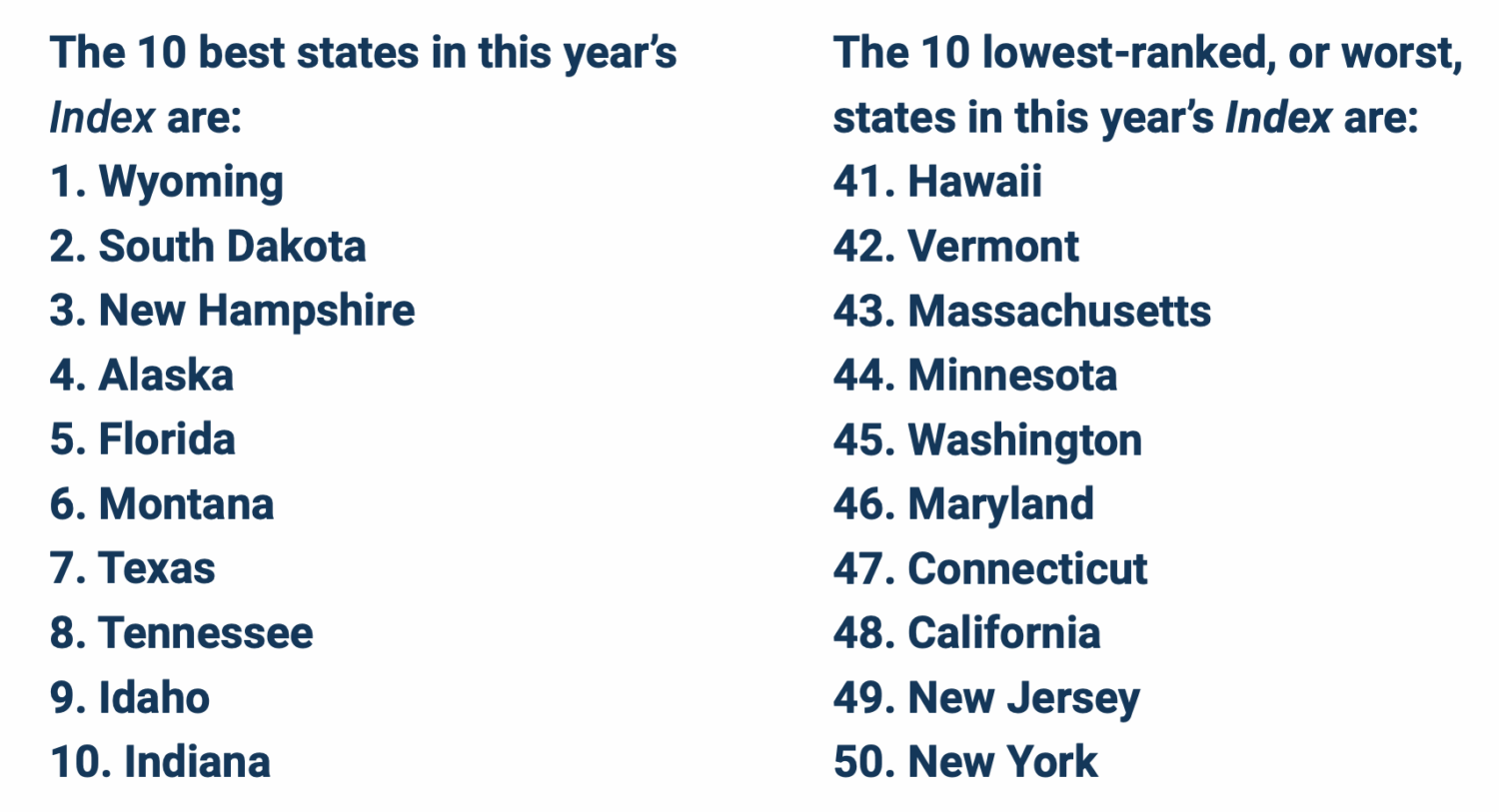
No other New England state placed in the top 25, and three are in the bottom 10. Maine ranked 26th, Rhode Island 40th, Vermont 42nd, Massachusetts 43rd, and Connecticut 47th.
Massachusetts fell two spots in this year’s index, while Vermont fell one, Maine rose three, and Rhode Island fell one. Connecticut’s ranking did not change.
New Hampshire’s Interest and Dividends Tax was taken off the books Jan. 1, making New Hampshire the ninth state with no tax on personal income.
While the jump in the tax competitiveness ranking is the most dramatic representation of the impact of eliminating this tax, there are others. The American Association of Retired Persons (AARP) this year included New Hampshire in its list of states where retirees will face no tax on personal income, including investment income.
“New Hampshire ranks as one of the most tax-friendly states in the Tax Foundation’s State Tax Competitiveness Index. It has no income tax and is one of five states with no sales tax,” the AARP told its members. “The Granite State also doesn’t have an estate or inheritance tax. Starting in 2025, it will no longer tax interest and dividend income.”
Word about the tax advantages of living and investing in New Hampshire is getting around. The state’s top-three finish in the Tax Foundation’s ranking should bring the New Hampshire Advantage to the attention of even more individuals, investors, and business executives looking for a better place to live, work, and invest.