

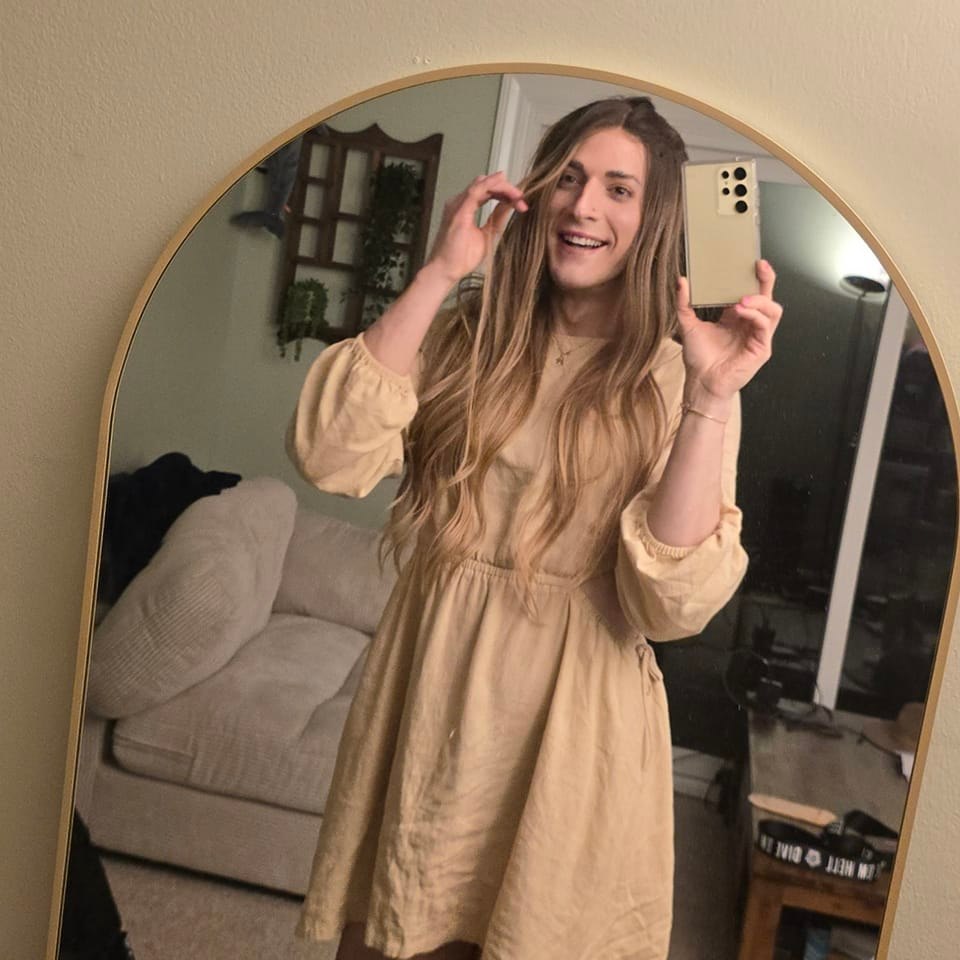
An Israeli secret agent, a computer genius, a startup entrepreneur, and a woman named Allison who interrogated a Seacoast man at gunpoint.
These are the many lives of Avishay Alon, a 33-year-old inmate suing the New Hampshire Department of Corrections over its treatment of Alon’s gender dysphoria.
Alon’s federal lawsuit, which demands a transfer to the women’s prison, gained media attention last week as another example of alleged anti-transgender discrimination. But many reports failed to explain how Alon, who had no prior criminal record, ended up serving a two-to-six-year prison sentence.
According to court records, Alon and codefendant Brian Levy held a man identified as M.P. at gunpoint for hours on Sept. 13, 2024, as Alon led the interrogation. Levy was sentenced to one to five years in prison for his role.
Alon was convicted on one count of criminal threatening with a dangerous weapon, one count of kidnapping, and one count of possession of illegal drugs. Kidnapping and criminal threatening are serious felonies, not minor misdemeanors. A Class A kidnapping conviction, for example, typically carries a prison sentence of 7.5 to 15 years.
So how did a “nice Jewish boy,” as described in court filings, become a “nice Jewish girl” behind bars in New Hampshire?
Alon, who was born in Israel, served with distinction in the Israeli military, according to defense attorney Michael Iacopino’s sentencing memorandum.
“(Alon) was selected to serve in the Israeli Defense Force, Directorate of Military Intelligence — Unit 81,” Iacopino wrote. “Unit 81 is a secret technology unit within the Special Operations Division of the Directorate. Unit 81 was tasked with building and supplying cutting-edge technologies to Israeli combat soldiers and spies.”
After leaving Unit 81, Alon worked in high-level computer engineering jobs at Amazon and Microsoft before founding two startup companies.
Trouble began about two years ago, according to court filings, when Alon began treatment for gender dysphoria. Avishay Alon wanted to be Allison Alon, but the transition proved socially and emotionally difficult, Iacopino wrote.
“She had recently lost friends because of ‘coming out’ about her gender dysphoria and transition,” Iacopino continued. “She had recently broken up with her partner. She was experiencing emotional difficulties. She began using narcotic drugs. She saw both M.P. and Brian Levy as friends.”
Court records show Alon had begun hormone therapy but had not undergone surgery.
While the defense pointed to gender dysphoria as a factor, prosecutors offered a simpler motive: drugs.
According to court records, Alon was using methamphetamine and spending time with M.P. and Levy. In September, Alon began to suspect M.P. had put the drug GHB into Alon’s water bottle and was stealing from Alon’s home. Alon shared those suspicions with Levy.
Levy then proposed kidnapping and interrogating M.P., prosecutors said.
“(Levy) informed (Alon) that he had an ‘idea’ that was ‘a little extreme,’” prosecutors wrote. Rather than rejecting the plan, Alon embraced it.
“[Alon] did not make a single, fleeting error in judgment, but a series of criminal decisions,” prosecutors wrote.
That night, Alon and Levy lured M.P. to Alon’s Dover home. Alon carried two loaded pistols during the interrogation — one in a holster and another equipped with a silencer. Alon pointed the silenced gun at M.P. while Levy mostly stayed in the background during the two-hour ordeal.
Levy occasionally left the room to use methamphetamine, according to court records, but at one point took Alon’s second gun and assumed control of the interrogation.
The crime ended by chance. Police received a call from a local business reporting a suspicious vehicle in its parking lot. The vehicle was registered to Alon.
The officer ran the plates and went to Alon’s home to request that the vehicle be moved. When the police knocked on the door, the interrogation stopped. Alon disassembled the guns and opened the door slightly to speak with the officer.
Realizing an opportunity, M.P. called out for help. Police entered the home and intervened.
During a subsequent search, officers found a fanny pack containing Alon’s identification, credit cards, and methamphetamine, according to court records.
After conviction, Alon sought a sentence that would have avoided state prison time. Alon requested a 12-month sentence at the Strafford County House of Corrections, with credit for time already served. Iacopino argued the county jail offered better accommodations for transgender inmates than the state prison system.
“The conditions under which transgender inmates are often housed — either inappropriately matched facilities or protective custody — can result in de facto solitary confinement,” Iacopino wrote. “These conditions … can severely disrupt access to gender-affirming health care, such as hormone therapy or mental health treatment.”
Prosecutors countered that Alon should not receive a lighter sentence than Levy or others convicted of similar crimes based on gender identity.
“[Alon] requests an unjust, unconstitutional result: that this Court treat her egregious, criminal conduct less harshly than a similarly situated cisgender person, or even her co-defendant,” prosecutors wrote.
They argued the issue was one of equity.
Prosecutors prevailed, and Alon was sentenced to state prison. Alon is currently housed in a protective-custody unit for transgender inmates within the men’s prison.
Alon is now seeking a transfer to the women’s prison, access to different hormone treatments, and female grooming items, including razors and tweezers. The lack of injectable hormones and a close shave leaves Alon looking and feeling “too masculine,” according to the federal lawsuit.
The lawsuit also alleges harassment and discrimination by prison staff, including being referred to as “sir,” being told “you have a penis,” and being denied permission to wear women’s underwear.
Earlier this year, Gov. Kelly Ayotte vetoed legislation that would have barred biological males from being housed in women’s correctional facilities, juvenile detention centers, and commitment facilities. The bill had broad Republican support and strong public backing in polling, but Democrats prevented the House from reaching the two-thirds majority needed to override the veto.