inside sources print logo
Get up to date New Hampshire news in your inbox

Four Years Ago, Biden and NHDems Promised to Fix This Bridge. It’s Still Closed.

Four years ago this week, Tom Brady was the starting quarterback for the Tampa Bay Buccaneers, Cleveland’s baseball team was still called the Indians, and the Green Bridge in Woodstock was a rusted-out, rickety danger.

Today, Brady is no longer playing ball, the Indians are now the Cleveland Guardians, and the Green Bridge is still a rusted-out, rickety danger.

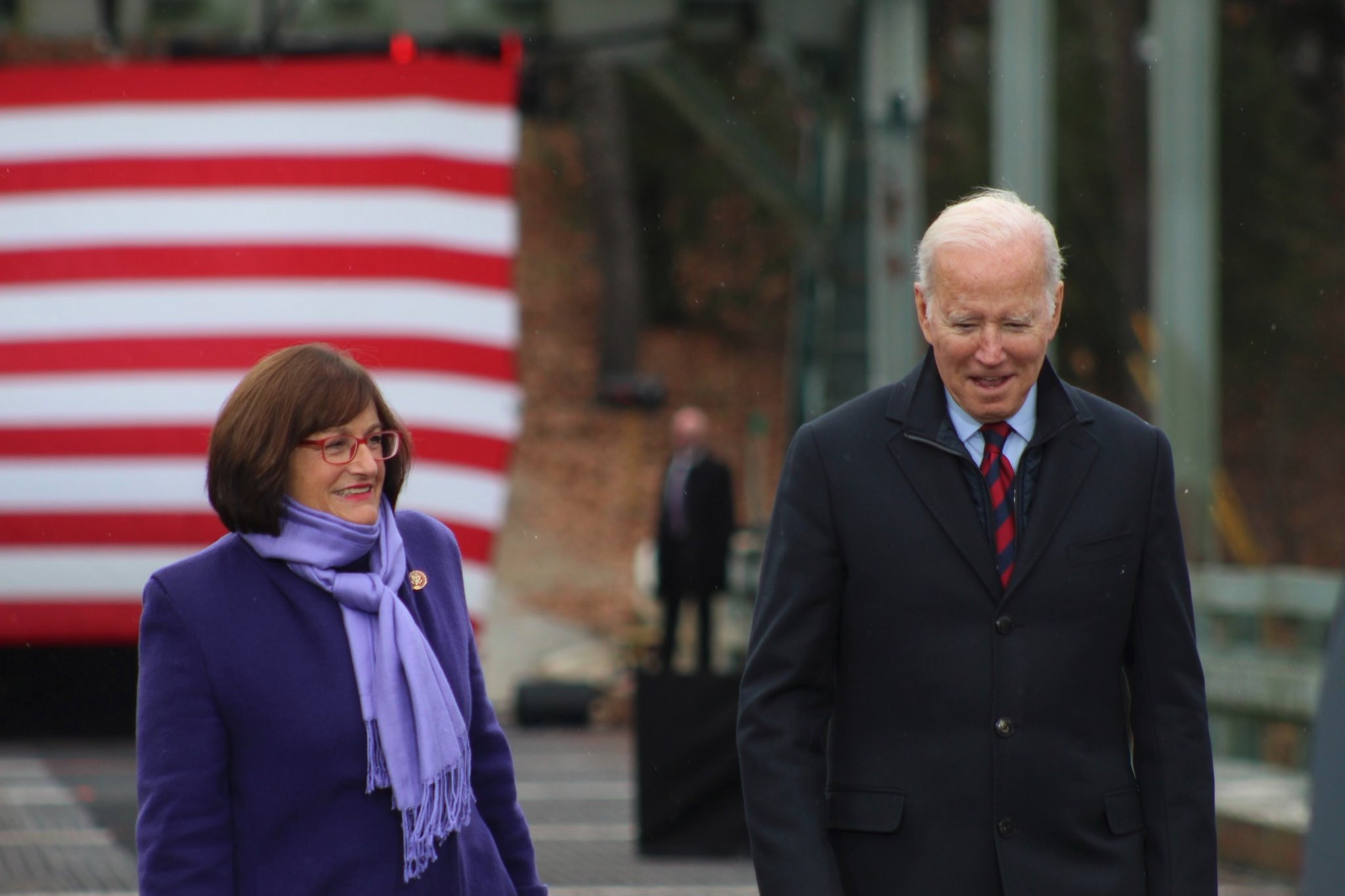
On Nov. 16, 2021, President Joe Biden and New Hampshire’s all-Democrat delegation walked out onto that bridge to tout their $1 trillion Infrastructure Investment and Jobs Act, promising the spending bill would finally fix the 86-year-old span across the Pemigewasset River.

“America is moving again, and your life is going to change for the better,” Biden said at the time.

But not moving very fast. According to Woodstock Public Works Director Mike Welch, the bridge won’t be completed anytime soon. In fact, as residents in the White Mountains resort town head to work on Monday, the bridge is expected to be completely closed to traffic.

The Green Bridge in Woodstock, N.H., November 2025
(CREDIT: Damien Fisher)

Months of work to strip old paint from the steel bridge and apply new coats are finally done, and the long-awaited structural repairs will begin. Steel cables need to be replaced, and the bridge deck must be lifted and rebuilt. Welch claims the project — managed by the state with state and federal funds — is surprisingly on target despite a four-year wait.

New Hampshire has listed the Green Bridge as unsafe since 2014. Despite Biden’s promises to boost the economy with increased infrastructure spending, the renovation has moved at the usual pace.

“I don’t know that it’s way behind,” Welch said.

Using nearly 100-year-old technology, the Empire State Building was built in less than 14 months. After Hurricane Ian cut off Sanibel Island from the Florida mainland, Gov. Ron DeSantis (R-Fla.) got emergency road and bridge repairs done in three days.

But four years after Sens. Maggie Hassan and Jeanne Shaheen stood on the Green Bridge, drivers are still restricted to one lane as the deck continues to deteriorate. The bridge’s current three-ton maximum vehicle capacity — imposed due to its poor condition — is well below the average weight of many full-sized SUVs.

The Green Bridge in Woodstock, N.H. November 2025.
(CREDIT: Damien Fisher)

And the contract completion date for the bridge is November 6, 2026 — almost another year away.

Now, people living on the other side of the river on Route 175 will need to detour miles out of their way to go about their normal routines. Welch said the inconvenience won’t affect many people. The 175-foot bridge typically carries about 570 cars a day.

“It’s not a high-volume road,” Welch said.

Kim Pickering, executive director of the Western White Mountains Chamber of Commerce, said most locals are already accustomed to getting around without the bridge.

“We’re New Englanders — we’re pretty adaptable,” Pickering said. “We’ve all gotten used to the limited access.”

Woodstock residents already deal with traffic surges during tourist season, Pickering said. Adding a detour for a largely residential area won’t disrupt business in town.

People who live on the other side of the river can get to nearby Lincoln to access I-93 or drive a few miles south to connect with Route 3. But the detour affects more than commuters.

Driving around the closed bridge is a mild inconvenience for an oil truck, school bus, or UPS delivery — but it’s a serious concern for fire trucks and ambulances, potentially losing minutes on their way to an emergency. The North Woodstock Fire Station is about a third of a mile from the Green Bridge and four miles from the next crossing over the river.

Since the Green Bridge became part of Biden’s spending agenda, he has lost his bid for reelection, Brady has gotten a facelift and become a broadcaster, and the Guardians have managed to put together three winning seasons out of four.

Shaheen Bragged About Writing $42 Billion Broadband Program. It’s Connected Zero People to Internet

One year ago this week, U.S. Rep. Chris Pappas was patting his own political back over nearly $200 million in federal tax dollars coming to New Hampshire to improve broadband internet access.

“Access to high-speed internet enables our businesses to compete, communities to thrive, and Granite Staters to succeed,” Pappas was quoted in a press release. “I was proud to help pass the bipartisan infrastructure law to secure these funds.”

He wasn’t alone.

Rep. Annie Kuster said she was “thrilled” by the broadband funding, and Sen. Maggie Hassan called it one of her “key priorities.”

And Sen. Jeanne Shaheen was the most excited of all, sending a “breaking news” press release taking credit for “writing the broadband provisions that created the BEAD program.”

“This is precisely what we had in mind,” Shaheen said of the $200 million broadband cash haul.

But ask Shaheen about the Broadband, Equity, Access, and Deployment (BEAD) program today, and she’s a “no comment.” The rest of the delegation is suddenly silent as well. 

Perhaps that’s because of a new report saying the $42 billion program launched in 2021 has yet to connect a single person to the internet.

Not one.

“In 2021, the Biden administration got $42.45 billion from Congress to deploy high-speed Internet to millions of Americans. Years later, it has not connected even one person with those funds. In fact, it now says that no construction projects will even start until 2025 at the earliest,” Federal Communications Commissioner (FCC) Brendan Carr reported.

According to the Washington Times, the reason Biden’s expensive, high-speed rollout is stuck in dial-up mode is progressive politics.

The law Shaheen helped write imposes burdensome requirements like climate change mandates, preferences for hiring union workers and the requirement that eligible companies prioritize the employment of “justice-impacted” people with criminal records to install broadband equipment.

“The Biden administration’s failure to turn even a single shovel’s worth of dirt with these dollars flows directly from its own choices,” Carr says. “The administration chose to pursue DEI goals and climate change priorities and to add layers of Byzantine process that senators warned would delay internet builds.”

Among the mandates is a requirement “to prioritize certain segments of the workforce,” such as “individuals with past criminal records” and “justice-impacted participants.”

Carr compared the years of spending and billions of dollars — all without result — to the recent news that Biden’s billion-dollar push for electric vehicle charger stations has led to just seven or eight actually constructed.

“A lot of people look at the seven EV chargers, and they thought that was a big miss,” Carr said. “And you know, at least you got seven EV chargers. Here, we’ve got $42 billion, and we’ve got no shovels in the ground — nobody connected at all.”

As critical as high-speed internet service is for New Hampshire families, getting them connected is taking a back seat to a shopping list of liberal items, according to Sen. John Thune (R-S.D.). He joined nine other Senate Republicans in a letter to the National Telecommunications and Information Administration (NTIA) demanding the agency drop its “bureaucratic red tape and far-left mandates” that have kept the program offline.

“As numerous states and stakeholders have articulated, current BEAD rules divert resources away from bringing broadband service to rural America in a manner that is inconsistent with NTIA’s statutory authority in the Infrastructure Investment and Jobs Act (IIJA). NTIA’s failure to resolve these concerns will prolong the digital divide and put billions of scarce taxpayer dollars at risk,” the senators wrote.

Meanwhile, Carr says, the Biden administration has added insult to injury for Americans in rural areas like northern New Hampshire who could have been helped by the BEAD program.

“While the Biden administration’s $42.45 billion plan from 2021 has not resulted in even a single shovel’s worth of dirt being turned, the government in 2022 revoked an award to Starlink that would have delivered high-speed internet to 642,000 rural locations,” Carr said.

Worse, Carr said, a group of moderate Republicans led by Sen. Susan Collins (R-Maine) wrote the Biden administration in 2022 warning the heavy-handed regulations proposed for the BEAD program would prevent it from fulfilling its mission.

“Certain provisions go beyond the authority granted to NTIA and will discourage or deter broad provider participation. This undermines our shared goal of delivering broadband service to all Americans as soon as possible,” the senators wrote.

Then, as now, the New Hampshire delegation had no comment.

New Hampshire Is King of the Road

Start your engines and get ready to roll: New Hampshire has been rated with the best roads in the country at one of the lowest costs per mile.

Moneygeek, a personal finance website, looked at road conditions throughout the country using data from the United States Department of Transportation and other sources and found New Hampshire is king of the road.

Gov. Chris Sununu was quick to take a victory lap, saying good government and smart investments are responsible.

“New Hampshire has made smart investments in our infrastructure, and we’ve returned over $100 Million to cities and towns across the Granite State for roads and bridges,” Sununu said. “It’s with that sense of smart fiscal management that we’ve paved the way to be ranked the #1 state for taxpayer return on investment.

New Hampshire also has one of the lowest road costs, spending $9.63 per mile, according to the study. 

California, Rhode Island and Nebraska have the roughest roads in the country, despite California and Rhode Island outspending the Granite State by miles. California spends $23.16 per mile and Rhode Island spends $42.37. Nebraska’s rough roads at least come cheap, with Cornhuskers spending $5.66 per mile.

Road conditions are vital to economic growth and personal finances. Better roads mean it is easier to ship goods, making it possible for businesses to grow and flourish. At the same time, good roads make it possible for residents to take part in the economy while spending less to maintain their own care.

“The roads sector is critical for local, national and international transportation of goods and services. More than ever, roads are essential in supporting economic growth, enabling socially distant travel and connecting communities,” said Murray Rowden, Americas Managing Director and Global Head of Infrastructure at consulting firm Turner & Townsend.

Jerry Wilson, Chief Editor at Complete Auto Guide, said good roads don’t just happen. They represent one of America’s greatest achievements.

“Anyone who thinks that good roads and infrastructure are God-given and not one of the United States’ greatest achievements should move their eyes to other countries and see how the lack of infrastructure keeps them in poverty. You won’t be able to jumpstart an economy when a 20-mile trip is a big ordeal,” Wilson said.

State and local government spending accounts for nearly 75 percent of the funding for roads and highways, with the federal government making up the rest. New Hampshire maintains its 17,000 miles of roads mostly with gas tax and motor vehicle registration revenue.

New Hampshire has managed to keep its roads level despite getting some of the lowest federal funding for roads and highways. In 2021, the Biden Administration set aside $1.1 billion for New Hampshire’s roads in the trillion-dollar infrastructure bill, the least amount of funding any state received. 

New Hampshire Department of Transportation Commissioner Bill Cass said New Hampshire can thank its many professionals who make sure everyday people can get there from here, even without tons of help from the feds.

“New Hampshire is blessed with a dedicated team of professionals that works hard to build and maintain our transportation system and I’m honored that we are being recognized for our work. I credit their commitment to our asset management strategy and sustained investment to our success,” Cass said.

Meanwhile, Granite State Democrats are pushing for an $800 million commuter rail proposal, approximately half of which would come from state and local taxpayers. Transportation officials fear siphoning off hundreds of millions in transportation funds for a rail system only a few Granite Staters would use could leave roadways underfunded.

“It’s a terrible idea,” Sununu said of the commuter rail proposal during a WGIR radio interview Thursday morning.