
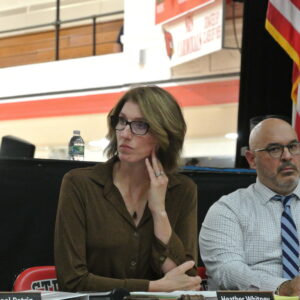
Hundreds of residents packed the Stevens High School auditorium Wednesday night to hear how the school board plans to navigate a multi-million-dollar budget crisis that could shut down schools for the foreseeable future.
Notably absent from the meeting were Superintendent Chris Pratt and Business Administrator Mary Henry. When pressed by members of the public about their absence, board attorney James O’Shaughnessey said he was legally limited in what he could disclose.
“The superintendent is not here tonight at the request of the board,” O’Shaughnessey said.
As for Henry—whose tenure coincides with the start of a deficit that could reach $5 million or more—O’Shaughnessey confirmed she is no longer managing the district’s finances.
“The business administrator is not in charge of Claremont’s finances any longer,” he said.
Both Pratt and Henry remain employed by the district, O’Shaughnessey added, though he implied changes may be coming. Pratt is technically employed by SAU 6—the supervisory union that includes Claremont and Unity. The SAU 6 board, which has the authority to dismiss him, is scheduled to meet Thursday night.
When asked whether anyone could be held criminally liable for the deficit, O’Shaughnessey said the problems appeared to stem from incompetence rather than fraud.
“There is no evidence we’ve encountered of fraud, theft, or misappropriation. It’s problems with financial records and poor management,” he said.
Independent auditor Michael Campo of Plodzik and Sanderson, P.A., suggested the district consider a forensic audit to determine whether fraud occurred. Such an audit would be costly and time-consuming, he said, but should be considered once the district stabilizes its cash flow.
Pratt, the former Stevens High School principal, became superintendent in January 2024 after the SAU 6 board fired Superintendent Michael Tempesta. Henry began in 2023 following brief stints as business administrator in the Fall Mountain and Hillsboro-Deering districts, where audits flagged serious record-keeping problems.
Campo said his firm is only now completing the 2022 audit because district officials repeatedly failed to provide required information.
“It’s been a challenge since the change of management and an inability to get information from management,” Campo said, noting that the audit will carry a negative review indicating significant accounting issues.
Campo added that the most severe financial problems likely began during the 2023 and 2024 fiscal years.
“I believe that is where there are significant issues with cash flows,” he said.
To stabilize the situation, O’Shaughnessey has hired Matt Angel, an experienced school business administrator, to serve as an advising comptroller while the board investigates the crisis and develops a plan to keep schools open.
“That financial picture has not been crystal clear,” O’Shaughnessey said. “There is no immediate or easy solution to the cash flow problem. It’s going to take time and more information to come up with a recovery plan.”
Board Chair Heathy Whitney said the district still lacks a concrete proposal to address the deficit, describing the crisis as comparable to the COVID-19 pandemic—except without outside aid.
“Unlike COVID, there is no state or federal funding coming to help,” Whitney said.
A letter from newly appointed Education Commissioner Caitlin Davis, received just before Wednesday’s meeting, made that clear. Davis wrote that the state will work with O’Shaughnessey but emphasized the issue remains a local one.
“At this time, this remains largely a local issue for Claremont School District,” Davis wrote, adding that the state expects audits to be completed, spending accounted for, and safeguards established.
O’Shaughnessey noted that bankruptcy or receivership would require legislative action. While schools are still scheduled to open in eight days, he said the board may consider delaying the start of the school year.
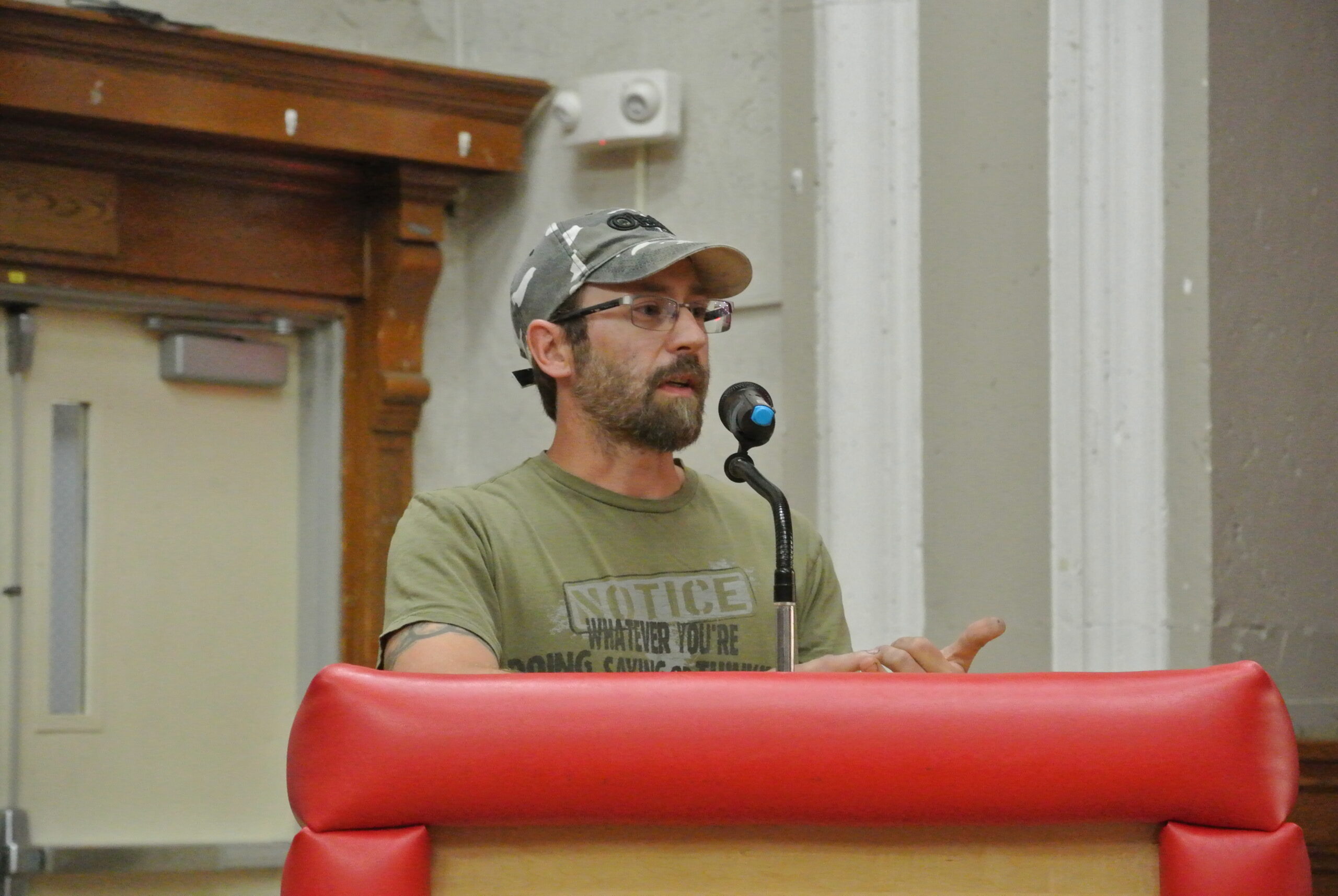
Claremont resident Zack Greenwood said he can’t afford to live in the city because of the failing school district.
Residents at the meeting voiced frustration and fear, citing soaring property taxes, declining enrollment, and poor student performance.
“I want to believe in the school board, I want to believe in the administration. But I want to know there are controls in place,” said resident Jerry Cross. “I love Claremont, I’ve been here 48 years, but there is something seriously wrong here.”
Cross said his property tax bill has doubled in the past year. Others said they can no longer afford to live in the city.
“You’re going to lose your community. The town is in peril,” Cross said.
Resident Zach Greenwood said he plans to put his home on the market, citing rising taxes and declining schools.
“We all vote for you to oversee these things—we shouldn’t be in this problem,” Greenwood said. “My kids’ education is crap, and the school management is crap.”