
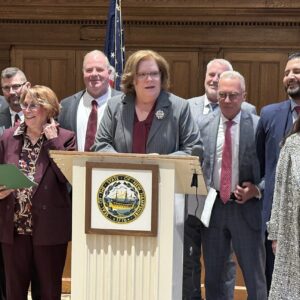
Declaring that their policies have “put the Granite State on the map and put our state on the path to prosperity,” state Senate President Sharon Carson and the GOP caucus outlined their legislative agenda for 2026 on Wednesday.
“Last year, we promised results, and we delivered. Republicans crossed every single item off our 2025 agenda,” Carson said. “This year, our agenda is even more ambitious, and I am certain that Senate Republicans will come through for New Hampshire again.”
Republican senators also pushed back on Democratic claims that GOP tax cuts and school choice policies have starved local schools and towns of revenue, forcing them to raise taxes.
“Idiotic,” said Sen. Tim Lang (R-Sanbornton). “Just look at the numbers: a 104 percent increase since 2020 in revenue given to towns.”
“We give them more money for roads, more money for water infrastructure, more money for education, more money through the rooms and meals tax,” Lang added. “That whole concept that we’re starving towns is ridiculous.”
Calling it the “Protecting the NH Advantage Agenda,” the policy’s centerpiece is fiscal restraint, both at the state and local levels. It includes a constitutional amendment requiring a two-thirds supermajority vote in the legislature to raise existing taxes or create new ones.
Republican senators also propose requiring a public notice period before local officials can override a local spending or tax cap, as well as requiring a roll-call vote for any such override.
Senate Majority Leader Regina Birdsell (R-Hampstead) highlighted the caucus’s focus on public safety, building on the passage of bail reform last year.
“We have officially banned sanctuary cities, and this year we will continue to stop the Democrats from protecting criminals and illegal criminal aliens over Americans,” Birdsell said.
Addressing one of the state’s most pressing economic hurdles, Sen. Dan Innis (R-Bradford), laid out a strategy to alleviate the housing crisis through what he called a “free-market approach.”
“Young families are struggling to find housing they can afford,” Innis said. “We need to continue to cut regulations and red tape that unnecessarily add months — sometimes years — to project approval times and tens of thousands of dollars in unnecessary costs.”
The GOP approach of tax cuts and spending caps stands in stark contrast to the “More Money in Your Pocket” proposal from Senate Democrats last month. Democrats called for a series of spending initiatives, including more state tax dollars for child care, pensions, housing, and local public schools.
Asked what their proposals would cost, Senate Minority Leader Rebecca Perkins Kwoka (D-Portsmouth) and her colleagues refused to give a number.
Perkins Kwoka responded to Wednesday’s GOP press conference with a statement accusing Republicans of “making life harder for young families, our seniors, and workers.”
“The only real agenda for the Senate Republicans is to distract us with bills focused on nonissues so that they can continue with their schemes, like their voucher giveaway that will cost taxpayers $110 million, their Medicaid income tax, their new fees, and their property tax hikes,” she said.
Asked about her claims that Republicans are cutting revenue to local governments and shifting costs to towns, Perkins Kwoka declined to respond. The same with House Minority Leader Rep. Alexis Simpson (D-Exeter).
Carson, however, came prepared, distributing a handout showing increased rooms and meals tax revenue since Gov. Chris Sununu and the GOP-controlled legislature boosted the distribution formula five years ago.
“In 2020, my district was given $2.8 million. In fiscal 2026, it’s up to $5.9 million, which is an increase of more than 105 percent,” Carson said. “We are giving this money back to the communities. The question people in the state need to ask is: ‘What is my municipality doing with this money?’”