

If it had been a fight, they would’ve called it.
The Portsmouth event, hosted Tuesday night by Americans for Prosperity–New Hampshire, was billed as the New England Tax Showdown. But if the data presented is any indication, it was less a showdown and more of a smackdown, as the Granite State bested the competition in virtually every category.
On income taxes, Massachusetts charges 5 percent, plus an additional 4 percent on income of $1 million or more. Maine has multiple income tax rates, ranging from 5.8 percent to 7.15 percent.
New Hampshire’s rate, as House Majority Leader Rep. Jason Osborne was happy to repeatedly note, is zero.

The AFP-NH gathering on New England states’ tax policy in Portsmouth, NH.
Grover Norquist, president of Americans for Tax Reform, is very familiar with the tax debate. (“Before I immigrated to the United States, I lived in Massachusetts,” he quipped.) He said that not only are Maine and Massachusetts taxing too much, but they’re on the wrong side of history. More states are moving toward New Hampshire’s example: either adopting a single income tax rate or trying to eliminate income taxes entirely.
“In the last four years, we’ve had seven states move to a single-rate tax, and that’s the trend,” Norquist said. “Three states — Kansas, Oklahoma, and West Virginia — have all passed laws that will get them to a single-rate tax in the next several years. There are another four or five states that will be adopting single-rate taxes.
“This will put us soon into a majority of states that have a single-rate tax,” Norquist said, adding, “Zero being my favorite single-rate tax.”
And it’s not just income and sales taxes. There’s also a significant difference in taxes on consumer products — the gap between tax rates on tobacco products, beer, and gasoline. The net result has been to send revenues soaring across the state line into New Hampshire.
Asked why the Bay State continues to raise those taxes and send more money across the border, Massachusetts Rep. Ken Sweezey offered a simple but unflattering answer.
“We’re stupid.”
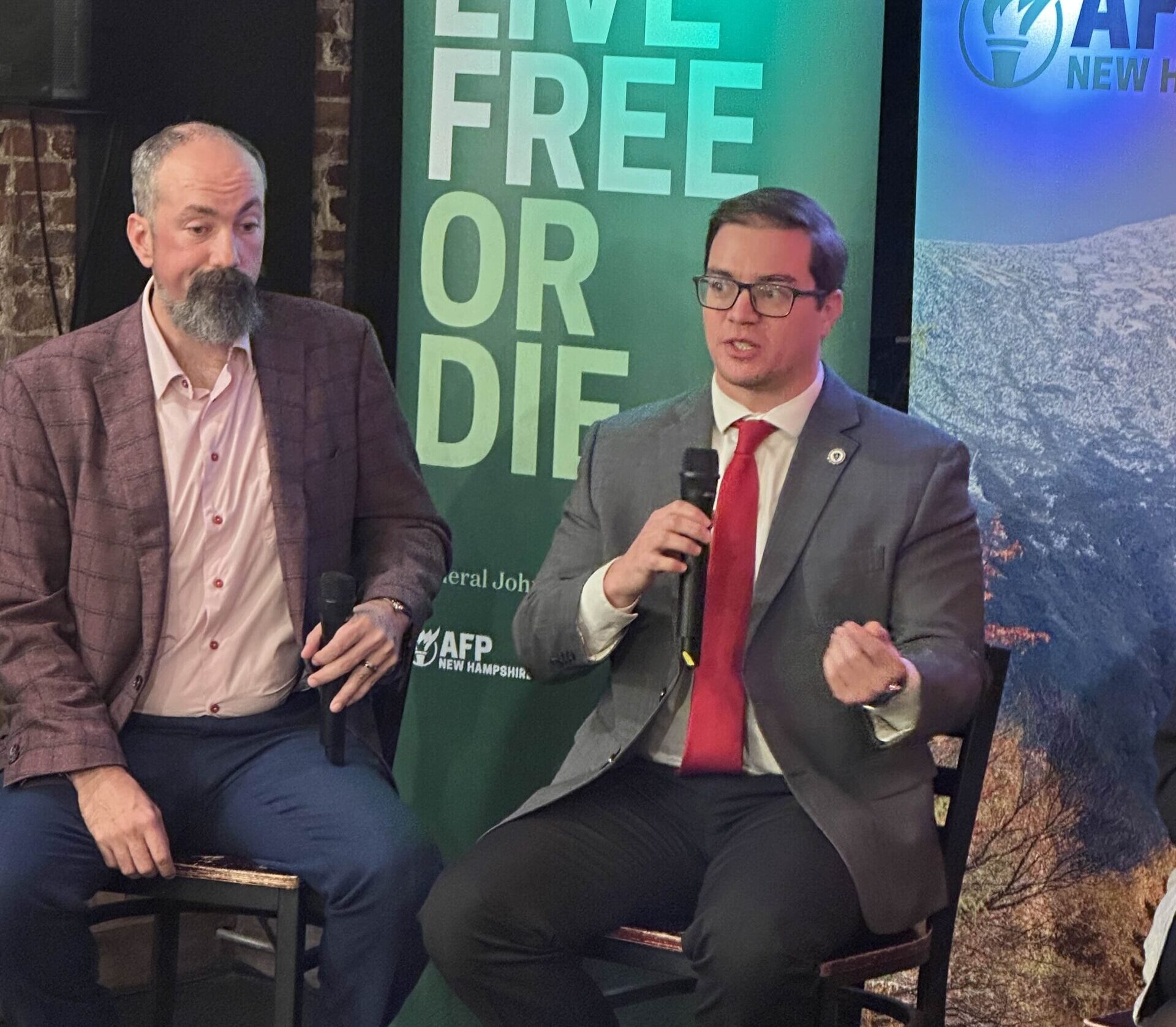
Rep. Jason Osborne (R) of New Hampshire (left) and Rep. Kenneth Sweezey (R) of Massachusetts.
As the Josiah Bartlett Center for Public Policy reports, New Hampshire is the third-highest state for cross-border cigarette purchases, thanks to the high taxes of its neighbors.
“From 2007 to 2022, New Hampshire earned $955 million in state revenue from cigarette buyers who then carried their purchases to higher-tax states,” according to the center.
And Maine just made the problem even worse in its latest budget, increasing the cigarette tax from $2 to $3.50 per pack — a 75 percent increase.
Sweezey, one of just 25 Republicans in the Massachusetts House of Representatives, drew gasps from the Republican-friendly crowd with the news that “We have only 7 million people in Massachusetts, and our budget was over $61 billion.”
New Hampshire’s $8 billion budget is far smaller, even when the population difference is accounted for. Massachusetts has five times more residents, but its budget is nearly eight times bigger than the Granite State’s.
In Maine, where Democratic Gov. Janet Mills and her party pushed through a series of tax hikes in the most recent session, the gap is even more startling. While Maine has a population almost identical to New Hampshire in both numbers and demographics, its 2025 budget spends $11.6 billion.
Maine Senate Minority Leader Trey Stewart said taxpayers in his state were victims of a political shell game, convinced to raise income taxes to increase teacher pay and improve public schools.
“What happened? Teachers weren’t paid more, and property taxes still went up,” Stewart said. “And by the way, we (Maine) now rank below Mississippi in terms of educational outcomes.”
Osborne credited his state’s willingness to forgo spending as the reason it’s been able to maintain the “New Hampshire Advantage” of no sales or income taxes. And despite the state’s less-than-stellar revenues over the past few months, he’s hopeful the Business Enterprise Tax (BET) can be brought down to 0.5 percent soon.
Asked by AFP–NH’s Sarah Scott about predictions that state government would go broke if GOP tax cuts were put into place, Osborne replied, “Unfortunately, yes: We still have government.”
The crowd, which included people from all three states and several Granite State lawmakers, liked what they heard. Among them was former Massachusetts U.S. Sen. Scott Brown, who’s running in the New Hampshire GOP primary to replace outgoing Sen. Jeanne Shaheen.
Brown told Norquist that the $39 trillion federal debt was his number one issue and asked the tax activist what meaningful action he thought Washington, D.C., could take to address it.
“The best proposal that’s been put forward so far was to take all the welfare programs and block-grant them to the states,” Norquist said. “If your state’s total [federal welfare revenue] is $2 billion, that’s what you get — adjusted for inflation and no more. And if your state can save money, you get to keep it.”
Norquist said that’s what happened with welfare reform and that states saved an average of 30 percent “because they went after the waste and fraud.”
In the end, however, the real problem appears to be politics. For whatever reason, people in Maine and Massachusetts are willing to pay higher taxes.
Sweezey noted that the reason Massachusetts has the so-called “millionaires tax” is because the people of his state passed it via ballot initiative.
“So it’s not just our governor but our fellow neighbors as well who want to be taxed into oblivion.
“Yes, it’s an uphill battle here in Massachusetts, but the Republican caucus is trying our best to play a little bit of defense with the limited bench that we have.