

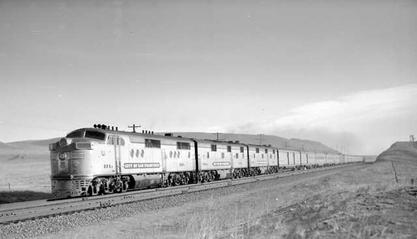
Getting there, they say, is half the fun. One group of travelers would have begged to differ. Because what should have been a brief trip 74 years ago this month turned into a disaster movie-scale nightmare. Think of it as “The Perfect Storm Meets the Donner Party.”
There was little reason for concern as 196 passengers and 30 crew members boarded a sleek streamliner train in Chicago bound for the San Francisco-Oakland area, 2,100 miles to the west. True, it was a long voyage, but the travelers were going in style.
The City of San Francisco was the pride of the Southern Pacific Railroad. In a time when airfare was still grossly expensive and federal interstate highways hadn’t been built, rail lines offered travelers a third option. The owners made this train as luxurious as possible.
The City was the way to go if you had to traverse the North American continent. (Railroads often named popular passenger trains after their destination cities back then. Remember The City of New Orleans in Arlo Guthrie’s classic 1972 song of the same name?)
Its many amenities made the 40-hour trip a sheer pleasure. There were reclining seats, sleeping berths with electrical outlets, an in-train phone system, a coffee shop, barbers and manicurists, and an array of rolling eateries offering everything from burgers and fries to a formal dining room with steaks and wines served on fine china and crystal atop linen tablecloths. All while clipping along at 110 mph.
The ticket cost around $68 (plus an additional 20 bucks if you wanted a lower sleeping berth), about $1,086 in 2026 dollars. Not cheap, but what a way to go!
And so powerful diesel locomotive #6019 rolled out of the Windy City in January 1952 — and sped right into a blizzard. Not just any blizzard, either, but a whopper. And it struck in the worst possible place at the worst possible time.
Even in good weather, the stretch of track nearly 7,000 feet above sea level between Sparks, Nev., and Roseville, Calif., that old-timers derisively called “The Hill” was challenging. Advertisements boasted “no tougher stretch of railroad in the country.”
The folks in the City of San Francisco were about to discover just how tough it actually was.
A blizzard howled into the area, carried by 100 mph winds. Over three days, it dumped 12 feet of snow, creating drifts as high as 25 feet in some spots. And that was the very area the City had to pass through on Sunday morning, Jan. 13.
Engineer Tom Sapanor had his work cut out for him. At 11:32 a.m., he slowly started the 15-car train (with two extra diesels behind his locomotive for good measure, giving him a combined 6,750 horsepower) heading into the Danger Zone.
It didn’t take long for trouble to strike. A 12-foot snowbank gave way, engulfing the City.
Sapanor tried every trick in the engineer’s book. First, he reversed; nothing. He tried to inch forward gently; again, nothing. He tried alternating between the two.
“That’s it,” he finally sighed. “We’re stuck.”
And so began a three-day ordeal.
The passengers stood it fairly well — at first. There were bridge games and sing-alongs in the lounge car featuring “California Here I Come” and (what else?) “I’ve Been Working on the Railroad.”
As Sunday gave way to Monday, things took a turn for the worse. The City was heated by steam. As the water supply gave out, the 22-degree temperatures outside began creeping inside. Batteries wore out, making the lights first dim and then flicker out.
Shivering travelers ripped down curtains and wrapped them around their feet. They smashed wooden furniture and built fires. And then there was the matter of using the facilities, with pots and pans pressed into service. (The less that about that particular hardship, the better.)
Given the circumstances, it was only natural that some passengers discussed the ill-fated Donner Party from a century earlier. “People talked about it quite a bit,” one later told reporters.
By Monday night, the snow was above the train’s windows, making it impossible to see out. The situation was rapidly becoming dire.
While all that was going on, rescuers frantically tried to reach the City. Four snowplows failed. The U.S Army, California Division of Highways, and Pacific Gas and Electric Company all sent rescue teams. In the end, volunteer skiers reached the stranded train and brought food, blankets and medical supplies.
“Everybody was bundled up in coats and blankets. Nobody said anything,” one rescuer later recalled. Additional supplies from a derailed supply train eventually arrived by dogsled.
After three harrowing days, the dazed, shivering survivors were led one by one to a nearby highway and then bused to the next stretch of clear track. There, they finished their journey, eventually reaching their destination not in the lap of luxury as they had started, but in old rattletrap cars from the 1920s that the railway was planning to scrap.
Everybody on board the City lived to tell the tale. Two heroic rescuers perished trying to reach the worst stranded train disaster in American history.