
The Claremont School Board fired 19 teachers on Friday as it scrambles to address an estimated $5 million deficit created through mismanagement.
Meanwhile, the district official who oversaw the budget fiasco will continue receiving a paycheck, after the board placed her on paid leave.
Now, desperate city leaders are asking the state to approve an emergency loan to keep the district open.
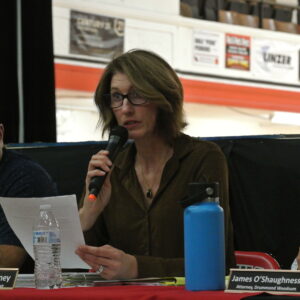
In an open letter to the community released Friday, School Board Chair Heather Whitney announced the firings along with other severe cost-cutting measures to get ahead of the multimillion-dollar deficit revealed in recent weeks.
“[Thursday] night, the Claremont School Board did not approve the nominations of 19 new teachers, a very difficult and unfortunate decision that will relieve approximately $1.8 million in expenses. Those teachers were new hires to the district and had not yet begun working with students,” Whitney wrote.
Whitney said the board’s next meeting, set for Monday, will address additional budget cuts and other painful measures aimed at keeping schools on track to open Aug. 28. According to Whitney, the board is “committed to preserving our community’s values as expressed at the August 20 school board meeting, while also honoring our obligation to provide a high-quality education for our students.”
Critics of the district dispute the “high-quality education” claim, noting taxpayers spend $23,000 per pupil—more than a typical private school education—yet just 36 percent of students are proficient in English language arts and only 20 percent in math and science.
By comparison, statewide averages are 56 percent proficient in English, 41 percent in math, and 36 percent in science.
Many critics blame SAU 6 Business Administrator Mary Henry for the fiscal mismanagement. Sources told NHJournal that Superintendent Chris Pratt, who took over in 2024, was instructed by the board to fire her. Pratt reportedly refused, and Henry was placed on paid leave instead.
The problem, according to those following the situation, is that Henry has a contract protecting her job, but cannot be allowed continued access to the district’s finances.
Whitney confirmed Henry’s paid leave in her letter. Henry was first hired in 2023, the fiscal year that auditor Michael Campo identified as the likely starting point for the district’s financial problems.
News of Henry’s paid leave status prompted mockery from some state legislators.
“Ah, yes, nothing says ‘fiscal responsibility’ like rewarding potential financial mismanagement with a taxpayer-funded vacation,” Rep. Lori Korzen (R-Berlin) posted on social media. “I’m sure the teachers who might lose their jobs due to budget cuts will really appreciate this creative approach to accountability.”
House Majority Leader Jason Osborne added, “How many more school administrators are going to try to earn themselves a free vacation in such a manner?”
Such criticism from Concord poses a problem for Claremont, which is hoping for outside help.
As the district prepares for another crisis meeting on Monday, City Councilor Nick Koloski has begun lobbying the state to allow a municipal loan. In a letter sent Friday, he asked lawmakers to change the law to permit a local financial rescue.
Municipalities in New Hampshire have greater financial flexibility than school districts through mechanisms such as enterprise funds and the ability to carry unassigned fund balances. Koloski wants to use those tools to provide a short-term emergency loan to keep the district open.
His letter argues that cities and towns should be able to step into such crises and make short-term loans or pay advances from available enterprise funds or fund balances. Any authority to do so, he wrote, should include strict repayment rules and significant oversight.
“This authority would not be intended for routine funding, but rather as a limited, emergency tool for extraordinary circumstances. With proper legislative guardrails, it could give communities the flexibility to support their schools when it matters most—without undermining fiscal accountability,” Koloski wrote.
Allowing Claremont to shoulder the burden may be what Concord prefers. State Education Commissioner Caitlin Davis has already told Whitney the crisis is a local matter, signaling that no state bailout is forthcoming.
Ultimately, Claremont homeowners are likely to bear the cost. The district will almost certainly need to ask voters for an emergency cash infusion, which would add to the already high local property taxes. Residents said at Wednesday night’s meeting that their tax bills have already doubled in the past year due to school spending increases, only to now discover the district cannot account for the money.
Why don’t residents know what happened to their tax dollars?
Claremont has not completed an audit since 2022, and while those records raised concerns, Campo said the serious deficit now confronting the district is not reflected in that fiscal year. He also reported that officials such as Henry and Pratt had not cooperated with his firm to complete audits, forcing him to ask the board to pressure administrators earlier this year.
At present, the deficit is estimated between $1 million and $5 million, the result of incompetence and inadequate oversight, according to multiple sources.
Matthew Angell, who had been serving as the district’s comptroller, is now being paid to serve as interim business administrator in Henry’s place, according to Whitney. Angell, an experienced school financial manager, was brought in soon after the deficit was uncovered.
That means Claremont taxpayers are now paying for two school business managers, while teachers are being fired and programs cut.
School is still scheduled to begin on Thursday as planned, but district officials warn that if they cannot meet basic financial obligations, classes could be shut down during the school year.