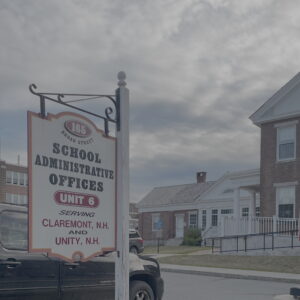
The Claremont School District misused federal grant money for years, using the funds to pay people it later could not identify during a New Hampshire Department of Education review, among other financial red flags.
NHJournal obtained several state compliance letters revealing the disarray inside the SAU 6 business offices that led to the state withholding all federal grant funding for most of 2024. While the issues that halted the money were supposedly corrected in October of last year, a blistering 59-page compliance letter sent to suspended Superintendent Chris Pratt in July cited a host of old and new federal grant violations.
Hundreds of millions of dollars in federal grant funding pass through the state Department of Education to local school districts every year, with the state responsible for making sure local districts follow federal requirements. Claremont received approximately $14 million in federal funds between 2022 and 2024.
The letters and reports obtained by NHJournal show the district repeatedly failing to meet basic guidelines for spending this money. District officials were also unable to account for how that money was used.
Both Pratt, who started in January 2024, and Business Administrator Mary Henry have been placed on paid administrative leave. The Claremont School Board learned of a multimillion-dollar deficit that appears to have begun sometime in 2023, when Henry was hired.
The district is seeking an emergency $4 million loan to keep schools open this year as officials try to resolve the fiscal issues and fill the funding gap.
According to the monitoring report sent to Pratt, Henry, and Assistant Superintendent Michal Koski on July 7 by NHED Administrator Ryanne Dennis, there was a great deal going wrong with the federal grants programs.
For starters, Claremont could not prove it used certified teachers or certified paraeducators for Title I services as required by federal law. That’s because the district apparently could not name the people it employed based on its own records.
“We noted that (Claremont) indicated that it did not know the names of the educators providing equitable services through 2023-2024 Title I, Part A Activity #151757. As a result, (Claremont) was unable to verify whether the educators providing these services met applicable state certification and licensure requirements,” Dennis wrote.
Title I also requires that the district inform parents when a teacher or paraprofessional does not have state certification. Claremont did not do that, either.
“(Claremont) did not submit documentation showing that parents were notified when a student was assigned or taught for four or more consecutive weeks by a teacher who does not meet state certification requirements,” Dennis wrote.
Claremont repeatedly failed to show that it was following guidelines for the money it accepted. Even though it took money to help homeless students, the district failed to have appropriate policies in place as required and failed to provide the services paid for by the grant. Dennis noted Claremont administrators pointed to a 2009 policy that has never been updated to show compliance in 2025.
In addition to its failings on behalf of public school students, records reviewed by NHJournal indicate the district is not following Title I rules for non-public school students, either.
Title I services, such as reading assistance, special education tutors, or vocational programs, are required for non-public school students. That has been part of federal law since President Lyndon Johnson signed the original Elementary and Secondary Education Act in 1965.
“Upon such review, we noted that (Claremont) did not have evidence of engaging teachers and families of participating non-public school students in the inclusion of family engagement services and activities,” Dennis wrote.
For the services it did provide non-public students, the district was inappropriately paying unknown third parties to provide these programs while exerting little or no control over the grant money. In one instance, Claremont paid a private school to operate a summer school program for private school students with no oversight from the district and no federally approved contract. When asked, Claremont officials could not even name the tutors who taught at the program.
“This response raises additional concerns regarding [Claremont’s] oversight and suggests that the non-public school may be controlling the provision of equitable services,” Dennis wrote. “This lack of sufficient written procedures for monitoring the federal programs in which non-public schools participate, combined with potential misuse of federal funds through possible direct payment to a non-public school, is non-compliant with ESSA.”
Dennis also noted there is no documentation showing Claremont does not use federal funds to supplant, or replace, local funding altogether.
Claremont had its federal funding withheld in April 2024 when district officials did not have any documentation prepared for a state review, according to an NHED letter sent to Pratt.
“Given Claremont School District’s failure to comply with the ESEA Federal Programmatic Consolidated Monitoring requirements, the New Hampshire Department of Education (NHED) is required to withhold federal funding as a remedy of noncompliance until [Claremont] can provide required documentation and sufficiently demonstrate federal funds are being administered appropriately,” NHED Administrator Emily Fabian wrote.
In August 2024, Fabian responded to Pratt’s inquiry about the funding by again explaining that the district needed to come up with a corrective action plan for failing to provide records.
“This act of noncompliance was one of many throughout the monitoring process, and as such, the New Hampshire Department of Education (NHED) implemented remedies of noncompliance,” Fabian wrote.
By the time Claremont managed to come into compliance for the 2024 review, it was October, and the district had already lost out on any federal grants with Sept. 30, 2024, deadlines. According to former Claremont School Board member Frank Sprague, administrators have yet to submit applications for $1 million in federal grant funds due at the end of this September.