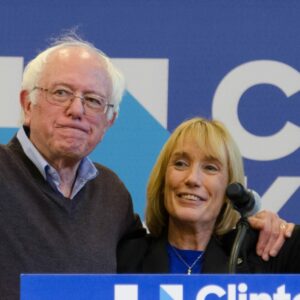
U.S. Sen. Bernie Sanders is coming to the New Hampshire AFL-CIO’s Labor Day breakfast on Sept. 1, but for Democrats who rely on the votes of organized labor, it could be a case of too little, too late.
“Sen. Sanders has stood shoulder to shoulder with our members—on picket lines, in union halls across the country,” said Glenn Brackett, president of the New Hampshire AFL-CIO. “We are thrilled to welcome him back to New Hampshire.”
But whether his members agree is an open question, and even Brackett’s fellow labor leaders are shifting toward the GOP.
For decades, Democrats have dominated among unions and their members in American politics while organized labor and the Republican Party have been wary adversaries.
But during Donald Trump’s presidency, the dynamic began to shift in ways that are still rippling through U.S. politics. Once entrenched on opposite sides, many union members—and in some cases, union leadership—have moved toward the Republican Party, drawn by a blend of populist economic rhetoric, skepticism toward globalization, and appeals to cultural issues that resonate with working-class voters.
The International Brotherhood of Teamsters, one of the nation’s most influential unions, released a poll in September 2024 showing 59.6 percent of its members wanted union officials to endorse Trump, while only 34 percent supported Vice President Kamala Harris. In a major break from tradition, the union declined to endorse either presidential candidate in 2024 — the first time in decades — and Teamsters President Sean O’Brien delivered a speech at the Republican National Convention in Milwaukee.
That new openness to GOP candidates is showing up in political donations. The Teamsters’ political action committee, Democrat, Republican, Independent Voter Education (D.R.I.V.E.), gave $5,000 to the National Republican Congressional Committee earlier this year, along with $62,000 in contributions to nearly two dozen Republican congressional candidates.
Closer to home, the New Hampshire SEA/SEIU held events for both Republican and Democratic candidates in the 2024 First in the Nation presidential primary. And the union endorsed Kelly Ayotte in the GOP gubernatorial primary.
“Our union, SEA-SEIU Local 1984, proudly endorsed Kelly Ayotte’s campaign, marking a significant shift from previous years — a return to cooperation and problem solving over partisanship and division,” union president Rich Gulla wrote in an op-ed earlier this year.
The ongoing shift raises questions about whether the traditional labor-Democrat alliance is giving way to a more competitive political landscape. Republicans, once seen as implacable foes of organized labor, now see an opening to win not just votes but, in some cases, public endorsements from union groups.
Some Democrats and labor activists argue that their membership has always been more bipartisan and that talk of a realignment is premature. They point to the success of Republican presidential candidates Ronald Reagan and Richard Nixon, who won rank-and-file votes long before Trump came down the golden escalator in 2015.
Asked if the movement toward the GOP is real among his members, Gulla said yes.
“I think it’s real. I think nearly half of union members vote Republican.”
Political analysts note that the trend is uneven—more pronounced in manufacturing, construction, and resource extraction unions than in public-sector or service-worker unions like Gulla’s. But it’s enough to potentially swing close elections in states like Pennsylvania, Michigan, and Ohio.
And if New Hampshire continues to trend red — Trump came within three points of carrying the state last year — the Granite State could be on that list, too.
The Teamsters still donate more to Democrats overall — including $15,000 to the Democratic Congressional Campaign Committee in April — but their increasing willingness to back Republicans marks a significant departure from past practice. The union also gave $50,000 to the Republican Attorneys General Association in June, and last year contributed $25,000 to the NRCC and $45,000 to the RNC.
“Unions aren’t becoming Republican institutions,” said one labor historian. “But their members are becoming less reliably Democratic. That’s a big change in the electoral math.”