Granite Staters, slow your engines.
That was the message on Wednesday when Gov. Kelly Ayotte joined top state officials to unveil a sweeping set of recommendations aimed at reducing deaths and serious crashes on New Hampshire’s roads and improving public safety.
There were 134 deaths on New Hampshire highways in 2023, a five percent increase over the year before, according to the report. A WalletHub study released earlier this year ranked New Hampshire the fourth-worst state to drive in, and gave it the lowest safety rank in New England.
Among the biggest challenges called out by Ayotte and the Governor’s Special Task Force on Highway Safety are the spike in speeding incidents involving speeds of 100 mph or more, the state’s increase in wrong-way driving, and the rate of drivers refusing to take blood-alcohol tests when stopped on suspicion of speeding.
“To ensure our state remains the safest in the nation, we must do better when it comes to saving lives and improving highway safety,” Ayotte said. “This report gives us a strong roadmap to keep drivers, road crews, law enforcement, and everyone who travels our highways each day safe.”
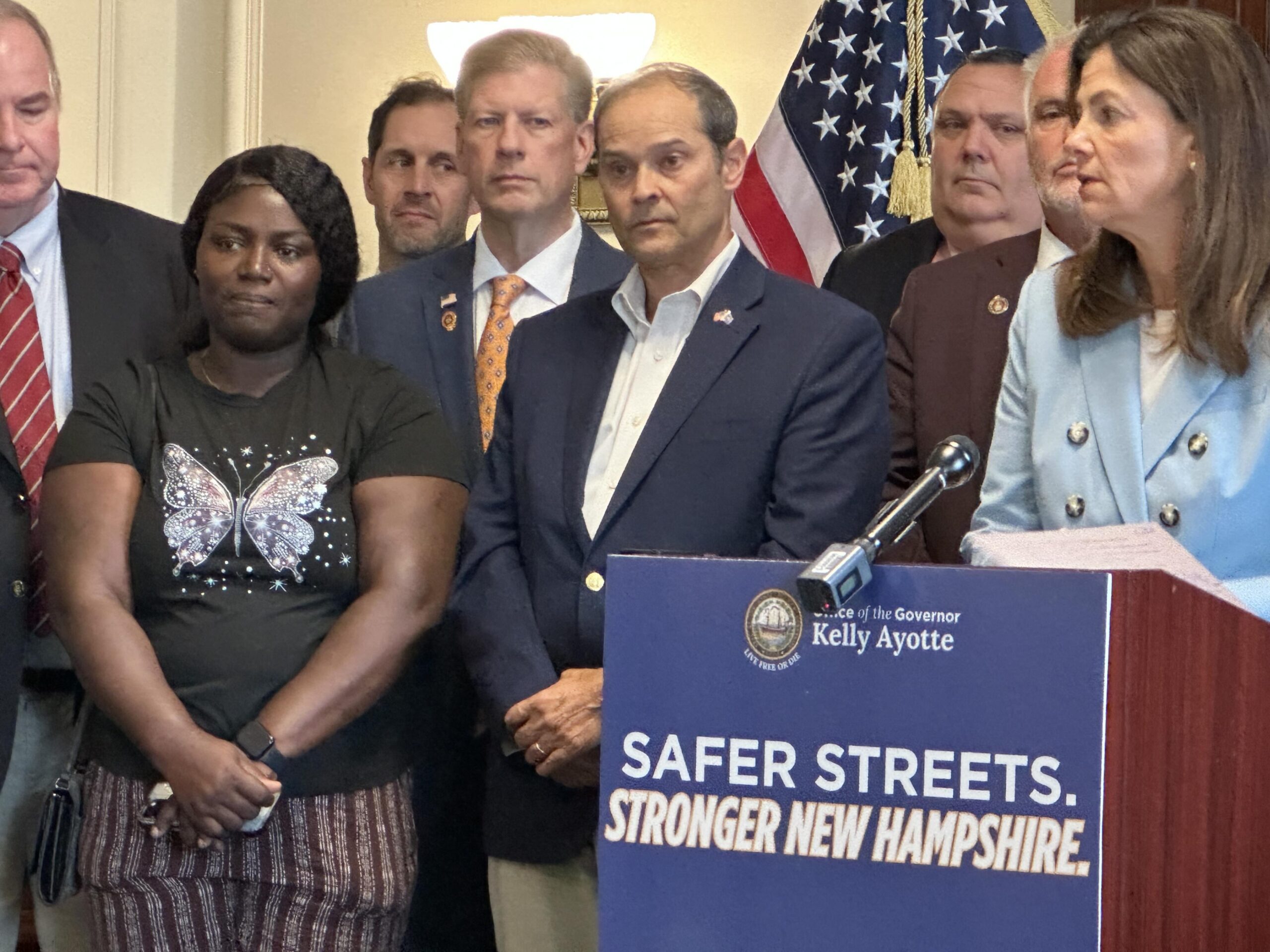
Gov. Kelly Ayotte thanks Lovety Cole (left) for participating in announcement of highway safety plan. Cole’s 11-month-old daughter was killed by an impaired driver.
She was joined by Department of Safety Commissioner Robert Quinn, Attorney General John Formella, and Executive Councilor John Stephen (R-Manchester), as well as department heads and members of law enforcement.
Also in attendance were Beth Shaw, a member of the task force whose son was killed by a drunk driver; and Lovety Cole, whose 11-month-old daughter “tragically lost her life when she was struck by a drunk driver in Manchester just walking across the street with her father to a playground,” Ayotte said.
The task force is just the latest initiative in Ayotte’s push to make public safety her signature issue. She’s already signed laws imposing tougher bail reform policies, banning sanctuary cities, and empowering a committee to review domestic violence-related deaths. The Republican governor also announced last week that she wants to see a return of the death penalty for police killers in the Granite State.
At Wednesday’s press conference, Quinn said the task force’s preliminary recommendations focus on increasing enforcement, enhancing training and education, and updating policies to target the state’s most dangerous driving behaviors — impairment, speed, and distraction.
“Nothing is more important than saving lives,” Quinn said. “Our residents and visitors should know we see what’s happening throughout the state, and we are committed to dedicating the fullest extent of our resources to combat these dangerous and deadly trends.”
One concerning trend is the number of drivers pulled over for suspicion of drunk driving who refuse to take a blood alcohol content (BAC) test, commonly known as a Breathalyzer. According to the task force report, New Hampshire has the second-highest rate of test refusals in the nation, behind only Florida.
“There are too many DUI refusals, and we have to equalize the penalties so people understand that if you’re driving intoxicated, you can’t just refuse to take the test and somehow avoid consequences,” Ayotte said.
Task force participants say the state’s balance between carrots and sticks when it comes to BAC tests is out of balance. Drivers who act in good faith, unaware of their level of impairment, and take the test often get far more severe punishment than those who refuse the test. One idea is for a driver’s willingness to cooperate by taking the test to have an impact on the case’s outcome.
On the “stick” side, the report notes that New Hampshire’s administrative license suspension for refusing a BAC test is 180 days, which is shorter than that of neighboring states. The task force recommends increasing that penalty and ensuring that administrative suspensions run consecutively to criminal sentences to deter refusals.
Ayotte noted that members of the state House and Senate were at the press conference, who, she said, could work with the task force on legislation to increase the consequences for drivers who refuse the test.
But Republican members of both chambers told NHJournal they weren’t on board with an approach they believe would undermine Fourth Amendment protections from unreasonable searches and seizures.
“We’re the ‘Live Free or Die’ state for a reason,” one GOP lawmaker said.
Formella said the recommendations represent “a strong and practical strategy” to make the state’s roads safer. And, he added, his office is already implementing the strategy.
“We’ve recently expanded our traffic safety resource unit to include a full-time prosecutor and a full-time investigative paralegal. And using that, we’re going to take these recommendations and really make sure that we’re working with law enforcement and prosecutors across the state.”
“Each of us — law enforcement, policymakers, and drivers alike — has a role to play in preventing crashes and saving lives,” Formella added.
Executive Councilor Stephen, who helped coordinate the task force, praised the collaboration among agencies, lawmakers, safety advocates, and victims’ families.
“Effective highway safety outcomes come not only from law enforcement, but from collaboration,” he said. “That’s what Gov. Ayotte did by convening this task force. I look forward to working with her to see these recommendations through.”
Extreme speeding and wrong-way driving were also identified as major safety threats.
“I was shocked at how quickly we saw people going over 100 miles an hour on our highways,” Ayotte said, recalling a recent State Police ride-along. “We really want to make sure people understand there’s going to be a heavy penalty for excessive speed.”
Quinn said state, county, and local law enforcement agencies are being asked to increase high-visibility patrols immediately, and the Department of Safety will move to enhance administrative license suspensions for reckless and dangerous driving.
“We’re pushing for new efforts to stop wrong-way drivers,” Quinn said. “These crashes continue to rise in our state and tend to be more severe, with devastating consequences.”
Asked how the state would pay for stepped-up patrols and local enforcement grants amid a tight budget, Ayotte said the funding is there.
“When it comes to public safety, it’s a top priority, and we will make it happen,” Ayotte said. “There’s no greater priority, and we’ll make sure the resources we have are allocated to this. If we need more, we’ll figure it out.”
The full Highway Safety Task Force report is here.