
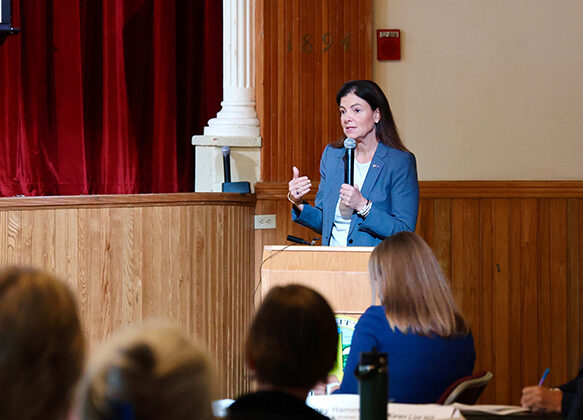
New Hampshire will receive more than $204 million in federal funding in 2026 to support rural health care under the U.S. Centers for Medicare and Medicaid Services’ Rural Health Transformation Program, the largest award to any New England state, Gov. Kelly Ayotte announced Monday.
The funding is the Granite State’s first major windfall from the One Big Beautiful Bill Act (OBBBA), the landmark budget reconciliation law signed by President Donald Trump in July. While the law has been a lightning rod for its sweeping Medicaid reforms, including a work requirement for able-bodied adults, Ayotte framed the award as proof that fiscal responsibility and rural health investment go hand in hand.
“We did this the New Hampshire way — with input from our providers, community health and mental health centers, and feedback from Granite Staters, and the hard work paid off,” Ayotte said in a statement. “This is the beginning of a bold effort to expand access to affordable, high-quality care closer to home.”
The award follows months of high-level lobbying by the Governor’s Office. Ayotte reportedly personally advocated for the state’s full $200 million annual request with HHS Secretary Robert F. Kennedy Jr. and CMS Administrator Mehmet Oz.
It’s another win for Ayotte’s strategy of avoiding direct conflict with the Trump administration — joining lawsuits, public criticism, etc. — and instead working behind the scenes for a deal with D.C. She took the same approach to securing federal education funding.
“Governor Ayotte has made improving rural healthcare a priority, and today’s grant is a massive step forward,” said spokesman John Corbett. “From directly advocating for our state with Secretary Kennedy and CMS Administrator Oz to hosting stakeholder meetings in the North Country, Governor Ayotte led from the front on securing these funds for New Hampshire and will continue to work every day to improve healthcare access and outcomes for Granite Staters.”
New Hampshire DHHS Commissioner Lori Weaver said the application reflected the specific needs of rural communities across the state.
“I thank CMS for providing this significant award to our state and recognizing that our application reflects the needs of our rural communities,” Weaver said. “It was important that the Department hear from as many stakeholders as possible as we worked to transform rural health care delivery in New Hampshire.”
To oversee implementation, Ayotte has created the Governor’s Office of New Opportunities and Rural Transformational Health, known as GO-NORTH. The state’s plan focuses on five core areas: preventive and behavioral health initiatives; improving sustainability and coordination among rural providers; expanding innovative care models; investing in technologies such as telehealth, data sharing, and cybersecurity; and workforce development to recruit and retain health care professionals in rural areas.
The New Hampshire Health Care Association, which represents long-term care facilities in one of the nation’s oldest populations, said the award exceeded expectations.
“Given tough state fiscal circumstances, we are grateful Governor Ayotte made a compelling case for federal investment,” said Brendan Williams, the association’s president and CEO. “Our long-term care system needs are workforce, workforce, and workforce, and the governor’s grant application recognized that.”
Republican Executive Councilor Janet Stevens called the award “big news for rural health in New Hampshire,” noting it was the largest CMS rural health award in New England.
The National Republican Senatorial Committee used the announcement to remind voters that U.S. Rep. Chris Pappas voted against legislation that created the Rural Health Transformation Program.
“Chris Pappas opposed President Trump’s historic investment in rural healthcare for New Hampshire earlier this year, only to turn around and demand free healthcare for illegals months later,” said NRSC regional press secretary Samantha Cantrell. “Pappas will throw Granite Staters under the bus every chance he gets to score political points with his radical base.”
Pappas’ office would not respond to NHJournal’s request for comment.
The $50 billion RHTP fund was specifically designed to stabilize rural providers as the OBBBA implements broader Medicaid spending caps and eligibility redeterminations.
Implementation of the New Hampshire plan is already underway, with the Joint Legislative Fiscal Committee recently approving the “accept and expend” request to begin distributing the first wave of investments in early 2026.
“Access to quality care should not be determined by your zip code,” the White House said in a statement late Monday. “Today’s announcement highlights the Trump Administration’s commitment to strengthening the rural health workforce, modernizing facilities and technology, and deploying innovative care models that bring high-quality health services to rural communities nationwide.”