
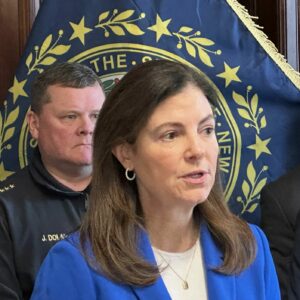
In an interview after Wednesday’s Executive Council meeting, Gov. Kelly Ayotte added to her tough-on-crime bona fides by calling for New Hampshire to bring back capital punishment.
New Hampshire abolished the death penalty in 2019, when the Democratic-controlled legislature, with the support of some libertarian Republicans, overrode a veto by Gov. Chris Sununu to pass the ban.
Ayotte believes that was a mistake.
“It’s the only piece of legislation as a private citizen that I came up and testified to the legislature about,” Ayotte told WMUR’s Adam Sexton. “I asked them not to repeal the death penalty.”
Ayotte has made public safety a top priority of her first term, signing a bill repealing the state’s bail reforms that allowed some violent offenders back on the street. One of them murdered his wife in a Berlin restaurant and then killed himself earlier this year. Thanks to the new bail law, the magistrate responsible for releasing him is out of a job.
Ayotte also alienated some of her fellow Republicans in the legislature with her aggressive push to get millions in additional retirement benefits for police officers and other first responders in the biennial budget.
For Ayotte, the death penalty issue is partly personal.
“I prosecuted the case involving Michael Addison, who murdered (Manchester Police Officer) Michael Briggs in cold blood,” Ayotte said. “I warned the legislature that by repealing the death penalty, we were going to see a situation we already see: Michael Addison is challenging the sentence that was issued by the jury, the death sentence. I warned the legislature at the time that he could raise that legal claim.”
In May, Addison’s attorneys filed a petition with the state Supreme Court seeking a review of Addison’s sentence in the wake of the 2019 law banning the death penalty, arguing that he should be given life in prison instead.
Rep. Jonathan Morton (R-Manchester) has pre-filed a bill “related to the offense of capital murder,” though no language has yet been released.
After seeing Ayotte’s comments, former state Rep. Steve Beaudoin (R-Rochester) posted on social media, “I supported the repeal when I served. I would not vote the same way today.”
According to the National Conference of State Legislatures, capital punishment is currently authorized in 27 states, as well as by the federal government. If New Hampshire were to bring it back, it would be the only state north of Philadelphia with the death penalty.
Ayotte said capital punishment “is important” when it comes to protecting law enforcement, “sometimes from very dangerous and career criminals.”
“That’s what we had in the case of Michael Addison, and that’s why I sought the death penalty as attorney general. That is one issue where I would like to see the death penalty restored.”
For Democrats, however, the death penalty is entirely a political problem. A party that’s already struggling on the issue of crime and public safety. While no recent polling has been conducted in New Hampshire on the issue, a September 2025 Washington Post-Ipsos poll found that Americans trust Republicans over Democrats on crime by a 2-to-1 margin.
Democrats are already paying a political price for their opposition to immigration law enforcement. The prospect of a 2026 campaign for New Hampshire governor — a race where Democrats still don’t have a candidate — while Ayotte and the Republicans are pushing legislation to bring back the death penalty for cop killers isn’t ideal for the Democratic Party.