

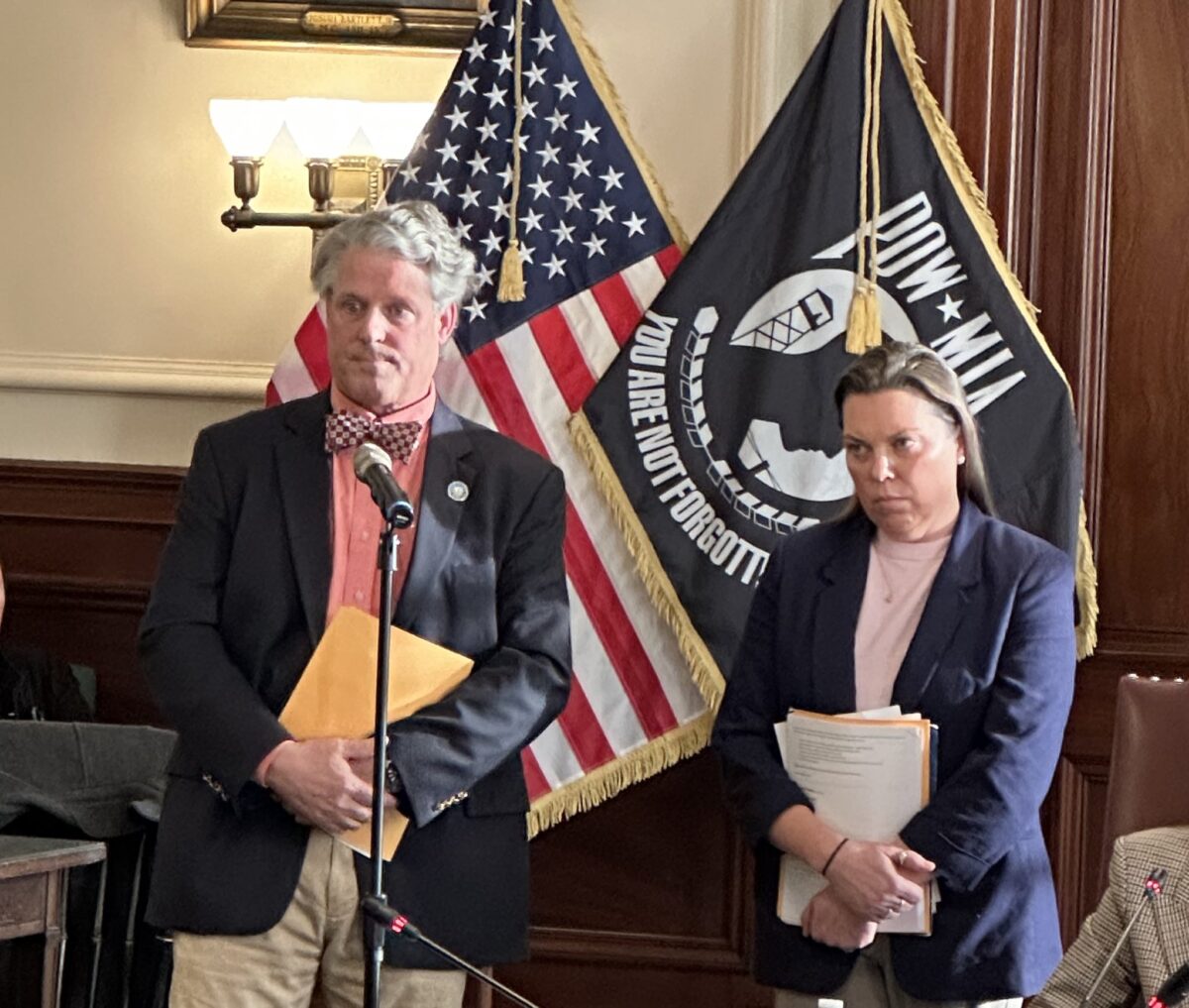
During a contentious appearance before the Executive Council on Wednesday, Department of Natural and Cultural Resources Commissioner Sarah Stewart ignored calls that she resign in the wake of her department’s mishandling of a high-profile interaction with the federal Department of Homeland Security.
Instead, the former GOP operative-turned-anti-Trump social media activist blamed her staff for Gov. Kelly Ayotte not being notified in early January about a federal contact regarding a potential ICE facility in Merrimack.
Stewart even brought an employee to appear before the council and apologize — something the commissioner herself failed to do.
“In my statement yesterday, I made it clear that the governor was not informed,” Stewart said.
“I did not know about the Section 106 consultation when it was received and responded to. I did not know about the right-to-know request when it was received and responded to. I learned about both yesterday morning when the governor’s chief of staff contacted me after the ACLU issued a press release.”
“My responsibility is to run a professional, lawful department that follows federal and state requirements and keeps the governor informed of sensitive matters,” Stewart said.
The ACLU of New Hampshire filed a Right-to-Know request on Jan. 26 and received a full response, including all relevant documents, less than 24 hours later—an unusually rapid turnaround. The ACLU released documents regarding the 50 Robert Milligan Parkway site, including a letter from Benjamin Wilson, director and state historic preservation officer.
When a councilor asked Stewart what went wrong, she offered up Wilson to apologize.
“I’m embarrassed by this, and I apologize to the governor, the council, and the senator from that district,” Wilson told councilors. “These are routine requests for reviews, and we don’t discuss politics in the office.”
The notion that a request from DHS to review a potential ICE detention facility is “routine” did not sit well with Councilor Dave Wheeler (R-Milford).
“Both you and the commissioner said this was routine, and for someone to come in and say, ‘We’re thinking about building a prison in New Hampshire,’ that is nowhere near routine. So I reject that argument,” Wheeler said.
Asked why such a politically charged request — coming amid anti-ICE protests across the country and in New Hampshire — did not catch his attention, Wilson said he does not closely follow current events.
“I’m no news hound,” he told the council.
Wheeler recounted a litany of leadership lapses by Stewart during her tenure as DNCR commissioner and called on her to resign.
“I have lost confidence in the leadership in your department, and I think you ought to consider moving up your resignation,” Wheeler said.
Stewart has already announced she will leave her job when her current term ends on June 2.
Democrat Karen Liot Hill (D-Lebanon) defended Stewart, telling fellow councilors that “systems break down, people are human, and humans make mistakes.”
And while Councilor John Stephen (R-Manchester) suggested the surprisingly swift response to the ACLU’s Right-to-Know request could indicate possible collusion, Liot Hill said it reflected well on Stewart’s work.
“I will note that is actually excellent turnaround — 24 hours to turn around a right-to-know request, I think, is acting in the public interest,” Liot Hill said. “And so at least on that point, the record does reflect that you were responsive.”
When it became clear that Stewart had no intention of resigning or apologizing, councilors asked what discipline the person she holds responsible would face.
The answer: none.
“I am in consultation with our in-house counsel and our HR department to have one-on-one conversations with the entire Division of Historical Resources to better understand what happened and where the breakdown was,” Stewart said. “I have spoken directly to the director, who has apologized to me for making a big mistake by not letting me know about this.”
However, Gov. Kelly Ayotte said the matter is far from over, telling Stewart that an internal review is not sufficient.
“I think it would be important to involve the Division of Personnel and the attorney general, so that we know what happened here, that we understand the lapse, and that it doesn’t happen again,” Ayotte said.
Ayotte also reminded the council that she did not appoint Stewart but inherited her. Commissioners’ terms do not coincide with the two-year terms governors serve.
“When a governor comes in, there are already people in place,” Ayotte said. “It’s very important that I have leaders who work with me and are willing to communicate with me, so that I can communicate with the people of New Hampshire on important matters.”
“I believe this was not a routine matter,” Ayotte added. “It’s important to me that commissioners communicate, and this was a serious lapse in communication.”