
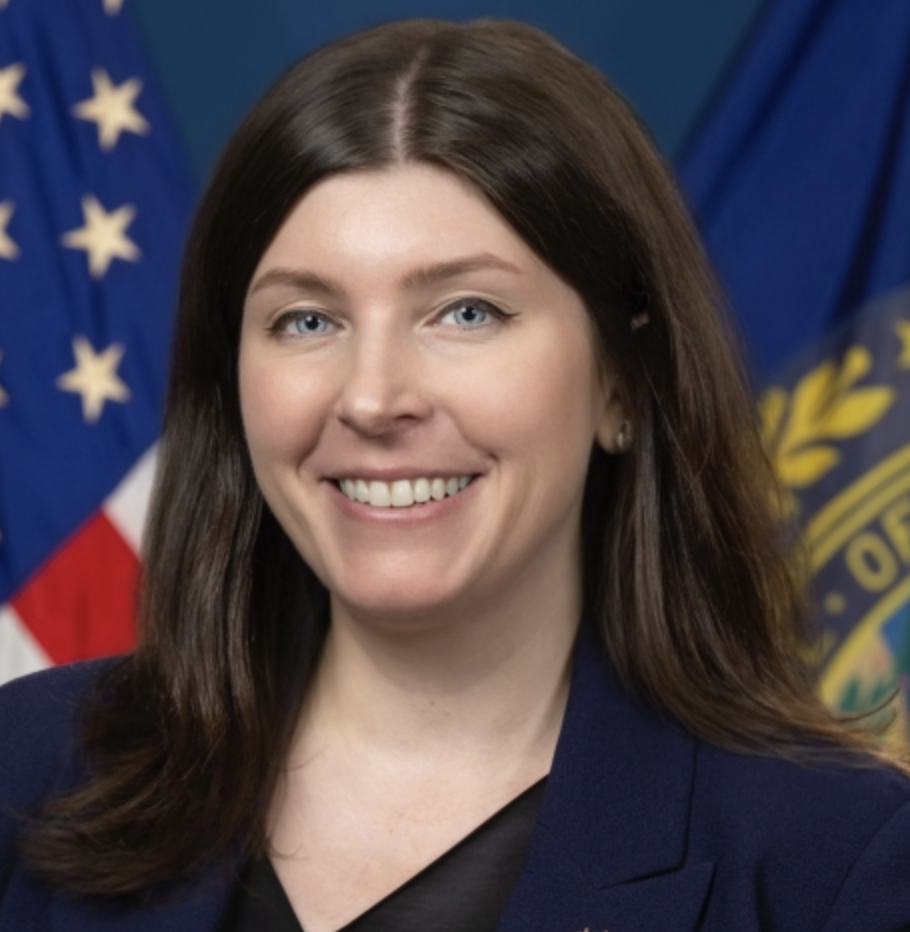
U.S. Attorney for New Hampshire Erin Creegan calls the Granite State the “tip of the spear” when it comes to new tactics in election fraud and campaign-related crimes.
“If there’s a new criminal way — a new mode of interfering with an election — we’re going to see it first,” Creegan said. “There’s not going to be a playbook. So we have to be really smart and ready to toggle to whatever the new thing is going to be.”
Creegan made her remarks during an exclusive New Hampshire Journal podcast interview. The wide-ranging conversation covered issues ranging from the decline in fentanyl deaths to fraud investigations stretching from Minnesota to Maine.
Confirmed by the U.S. Senate last year after serving as interim U.S. attorney, Creegan brings a national security background to the role. She spent more than a decade prosecuting counterterrorism cases at the Department of Justice following the Sept. 11 attacks before moving into senior positions at Main Justice and on Capitol Hill.
Now, she oversees all federal prosecutions in New Hampshire — a state she describes as low-crime compared to much of the country, but not immune from serious threats.
“We have the lowest homicide rate in the United States, strong social cohesion, and people who are willing to report crimes and testify,” Creegan said. “But we are not immune from drug trafficking organizations, violent street gangs, firearm trafficking rings, or crimes against children.”
Creegan said federal authorities continue to target international drug networks supplying New Hampshire, many of them linked to Mexican cartels and Dominican Republic–based trafficking organizations.
“Drug trafficking is a major, major component of federal enforcement,” she said. “It’s almost always international and interstate, which is why the federal government is particularly well equipped to track supply chains and dismantle networks.”
While opioid overdose deaths have declined sharply in recent years, Creegan cautioned against viewing the trend as an unqualified success.
“We are interdicting a lot of the supply, and drug courts and treatment efforts are helping,” she said. “But we’re also seeing a resurgence of methamphetamine use. It’s less likely to cause overdose death, but it’s extremely dangerous, highly addictive, and often associated with violence.”
Violent gangs — both national and international — are also a major focus.
“Sometimes people don’t realize we have very operational gang presence in New Hampshire,” Creegan said. “The federal government is very good at breaking up criminal networks and incapacitating gang members, and that’s something we are very focused on.”
Asked about investigations into alleged welfare fraud involving the Somali community in neighboring Maine, Creegan deferred to that state’s U.S. attorney.
“I wouldn’t want to get out in front of my friend and colleague, Andrew Benson,” she said. “But he is a very good prosecutor, and if there’s anything they find, I know he will be on top of it.”
A major audit of Gateway Community Services, a nonprofit provider serving Portland and Lewiston, Maine, prompted the state’s Department of Health and Human Services to suspend the organization’s MaineCare payments and refer the case for further investigation amid suspected fraud.
Agents from the U.S. Department of Homeland Security’s investigative arm have been reported visiting Gateway’s Lewiston office as part of broader law enforcement scrutiny of Medicaid billing practices.
In New Hampshire, Creegan said, anti-fraud efforts are increasingly focused on protecting the state’s large senior population.
“We have an older population, and they are targets,” she said, citing gold-bar scams, fake cryptocurrency schemes, and impersonation fraud using artificial intelligence.
And while Democrats in the Legislature have proposed bills to limit federal and local cooperation on immigration enforcement, Creegan said coordination between her office and state authorities remains strong.
“I get along very well with the attorney general and state law enforcement,” she said. “New Hampshire is a very pro-law enforcement environment. We’re all on the same team.”
Creegan described her approach as pragmatic rather than jurisdictional.
“If the state has the better charge, I will support them 100 percent,” she said. “And if we have the better tools federally, they support us.”
Some politically active Granite Staters have expressed frustration with what they view as minimal punishment for election law violations. Creegan said that given New Hampshire’s outsized role in national politics, her office is closely monitoring potential election law violations — particularly as campaigns grow more complex and technologically sophisticated.
“We have an election coordinator here who works closely with federal agencies and our state partners,” she said. “Every new set of facts requires us to look at who has what authority and what tools are available.”
Asked whether she would publicly address alleged abuses — such as illegal campaign mailings during the 2022 Republican primary in New Hampshire’s 2nd Congressional District — Creegan acknowledged public frustration but said Justice Department policy limits what prosecutors can say during ongoing investigations.
“The guidance is pretty Spartan,” she said. “Unless there’s an immediate public safety issue, we generally don’t comment.”
She said that restraint is intended to protect investigations and avoid harming individuals who may ultimately be cleared.
“I work for the people of New Hampshire — they are my boss — and I want them to know what we’re doing,” Creegan said. “But sometimes silence is necessary to preserve the integrity of the case.”