Don’t tell Greg Moore that business tax cuts are starving the state of revenue.
At a business roundtable hosted by Moore’s Americans for Prosperity organization on Tuesday, a group of small business owners and GOP state lawmakers made the case for newly proposed legislation to increase Section 179 business deductions and further lower the state’s Business Enterprise Tax (BET) rate.
(“179 deductions” let New Hampshire businesses immediately write off major equipment purchases instead of depreciating them — a key tax policy tool for encouraging in-state investment and job growth.)
Asked about complaints from Democrats that GOP tax policy was denying state government the income it needs to operate, Moore pointed out that when Republicans forced through the first round of business tax cuts in 2015 — over then-Gov. Maggie Hassan’s veto — the state’s biennium budget was $11.3 billion.
Five rounds of tax cuts later, the Business Profits Tax has been cut from 8.5 to 7.5 percent, and the Business Enterprise Tax from 0.75 to 0.55 percent. At the same time, the budget passed this year was nearly $16 billion, a 41 percent increase from 2015.
“It isn’t a lack of revenue, it’s a lack of self-control,” said Sen. Keith Murphy (R-Manchester). “Without naming names or pointing fingers, we’ve had a lack of self-control to restrain our expenditures.”
Rep. Brian Labrie (R-Bedford) owns Drop One Portables and B.H. Labrie Landscape Construction, and he called the Business Enterprise Tax and the Business Profits Tax “my two biggest enemies. They get you coming and going.”
Several participants noted that while New Hampshire has a clear advantage in competing with other New England states on broad-based sales and income taxes, business taxes are relatively high. In fact, Moore said, before the GOP-backed tax cuts, some large companies were going to Massachusetts rather than New Hampshire due to the Granite State’s tax policy.
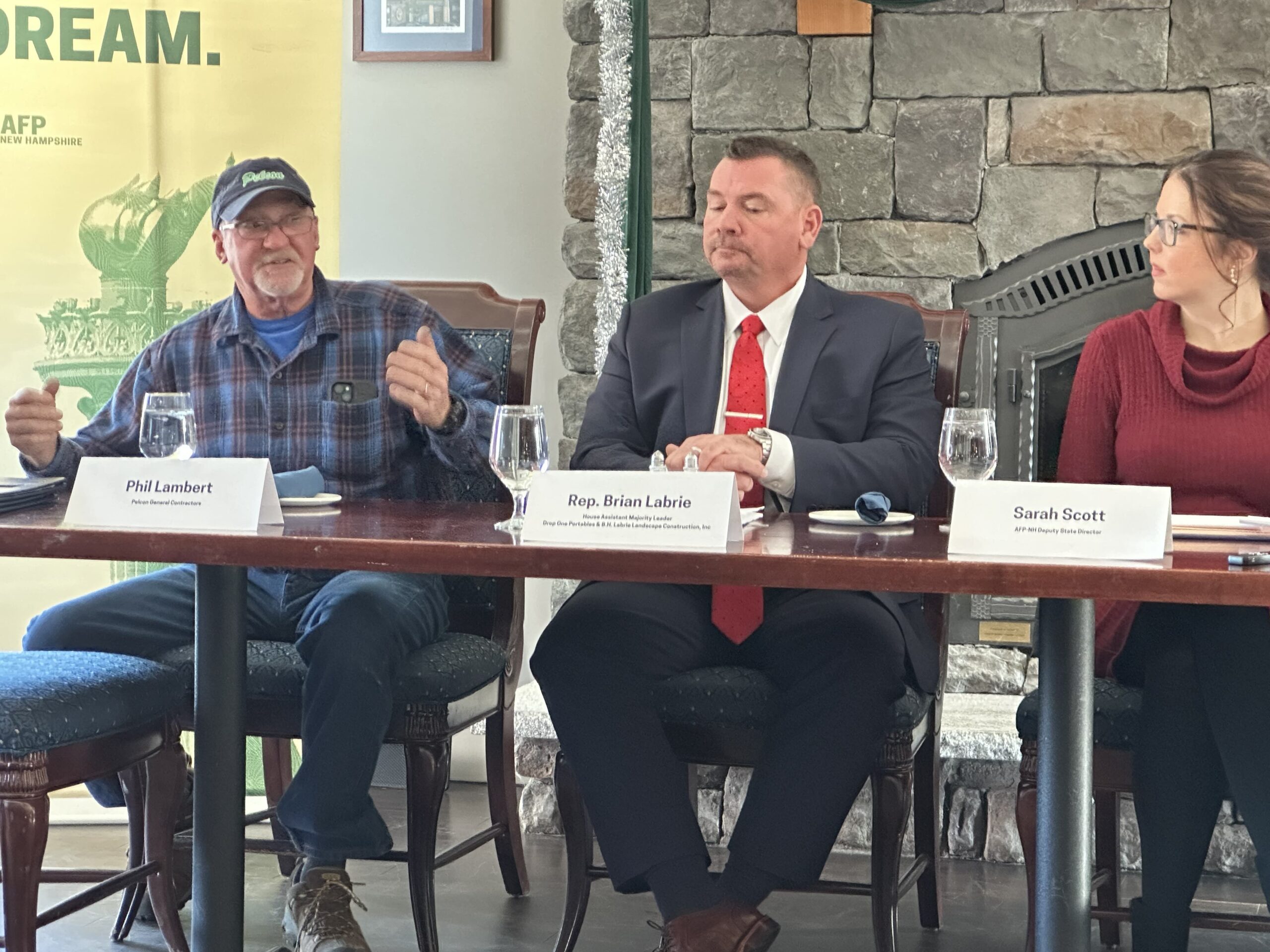
Patrick Binder of Timber & Stone Outdoor Spaces, Rep. Brian Labrie (R-Bedford) and Sarah Scott, AFP-NH Deputy State Director, participate in a business roundtable on December 9, 2025 in Bedford, N.H.
“These are high-capital companies that are paying a lot in the BET, but they weren’t profitable,” Moore said. “They were losing money and paying business taxes, and so they said, ‘This is crazy.’”
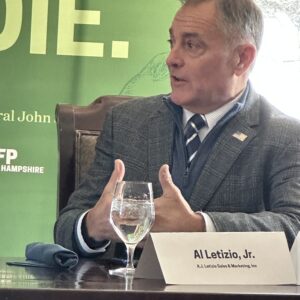
Now the business tax rates have fallen enough over the past decade to reverse that trend, said Al Letizio, owner of A.J. Letizio Sales and Marketing Inc.
“Businesses are starting to look at the delta between the two states. They’re saying, ‘Hey, you know, I’m in Methuen, Mass., or Lowell, and I could just locate over the border — this is real savings for me,’” Letizio said. “We already have an advantage, but if we can create a little bit more of a delta,” more businesses would cross the state line.
At the same time, participants acknowledged that the current budget climate is extremely tight and lawmakers need to move cautiously. Murphy, who hosted the event at his Murphy’s Taproom restaurant in Bedford, said, “I’ve never met a tax cut I didn’t like.
“Having said that, I think a lot rides on the next few months of revenue reports. The Senate is historically a bit more conservative than the House when it comes to tax cuts like this, especially when there’s a great deal of uncertainty.”
For example, Murphy said, “liquor sales are down a massive 26 percent in the last 24 months. And in a state that earns so much of its revenue from liquor sales, that’s bad news.”
While the conversation began with calls for tax cuts, it quickly moved to another major challenge for local businesses: the lack of workforce housing and its impact on an already tight labor force.
Phil Lambert with Pelcon General Contractors shared his story of preparing for retirement by working on some housing deals with family members to show them the ropes.
“I said, ‘I’ve got an opportunity, let’s flip a couple of houses and show you guys how to do this,’” Lambert said. “I was amazed, because I haven’t flipped a house in years. I’m putting the numbers together, and it’s crazy. I still can’t wrap my head around the cost of everything.”
Several panelists pointed to local zoning boards making it unnecessarily difficult to build new housing.
“We cannot let the towns stymie growth,” Labrie said. “There’s no common sense in this, and we’ve allowed these planning boards and zoning boards to just completely go wild. And I think the state needs to step up and pass some legislation.”
House Majority Leader Jason Osborne (R-Auburn) was in the audience and was asked about the possibility of tax cuts getting through the legislature.
“Republicans in the House haven’t met tax cuts that they didn’t like, either,” Osborne said.
“I’ve learned two tricks when it comes to getting this stuff done. One is a little bit of ‘kick the can down the road,’ like we did with the BET reduction we’ll be voting on in January. It won’t take effect until 2027, so it’s always easier to get people to vote for something if they don’t have to deal with the consequences today.”
The other, Osborne said, was to have in-depth tax policy debates in non-budget years.
“When everyone’s fighting over spending money on all their favorite projects, it’s a lot harder to get people to talk about tax cuts,” Osborne said. “But in the second year, it’s a lot easier to say, ‘Hey, we should really think about doing some tax policy now that will take effect next year when we’re working on the next budget.’”
Osborne also praised the roundtable participants.
“There are other organizations that are meeting with businesses to talk about things like subsidies and mandates and protectionism,” Osborne said. “It’s good to hear small business owners talking about the things that will actually promote growth.”