
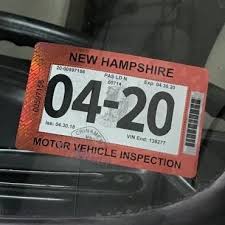
The company that makes money from running New Hampshire’s vehicle inspection system is throwing up a legal roadblock to the new law that ends the state’s inspection mandate. But GOP legislators say they aren’t about to hit the brakes on a popular reform that they argue will save Granite State drivers millions of dollars.
As of this month, New Hampshire is one of just 14 states that require periodic (usually annual or biennial) vehicle safety inspections for most passenger vehicles, a fact supporters of ending the mandate frequently touted. That mandate is scheduled to end on Jan. 31, 2026.
The amount of money is significant, says the Josiah Bartlett Center for Public Policy.
“There were 1,383,700 vehicles registered in New Hampshire in 2023, according to the U.S. Department of Energy, which collects vehicle data. At between $30 and $50 per vehicle, inspections alone likely cost Granite Staters approximately $41.5 million to $69.2 million a year. That doesn’t count any repair work required to pass inspection.”
Gordon-Darby, which provides auto emissions tests and related services in New Hampshire, has filed a 60-day notice of intent to sue the state, claiming the new law would eliminate the state’s emissions-inspection program without first obtaining EPA approval for changes to a preexisting State Implementation Plan (SIP) regarding ozone regulations.
“Congress explicitly included New Hampshire in the Ozone Transport Region (OTR) established in CAA (Clean Air Act) Section 184,” the lawyers for Gordon-Darby wrote. “As a member of the OTR, New Hampshire is obligated to maintain an enhanced vehicle I/M program in its SIP that applies to each metropolitan statistical area in the state with a population of 100,000 or more.”
Not so, says Rep. Henry Giasson (R-Goffstown), who told NHJournal the state’s CAA mandate expired in 2018. He also notes that what New Hampshire currently does isn’t an actual emissions inspection (“we don’t even have the equipment for that”) but essentially an “engine-light-on” report.
Instead of putting a sensor in the tailpipe to measure exhaust fumes directly, inspectors plug a scanner into the car’s computer port. The scan checks if the vehicle’s internal monitoring system has detected any faults. If the computer sees a problem, such as a sensor failure or a vapor leak, it triggers the “check engine” light.
“That doesn’t mean that your emissions have changed, but the way New Hampshire interpreted the rule was that any check engine light was an automatic emissions failure.”
As a result, New Hampshire’s current inspection regime has minimal impact on emissions overall, and on ground-level ozone-related gases in particular. But according to the latest data, it’s unlikely to matter anyway. Nitrogen oxide emissions (the pollutant responsible for ozone formation) from U.S. cars have plunged 95 percent since 2000. “The massive drop is driven by advanced three-way catalytic converters and computer-controlled fuel injection that are far more precise than those used 20 years ago,” according to the EPA.
“The bottom line is that cars and light trucks are vastly cleaner than when the Clean Air Act passed decades ago,” said Greg Moore with Americans for Prosperity, whose New Hampshire chapter championed the mandate-ending legislation.
“Comparing emissions from today’s vehicles to those in the 1970s is like comparing apples and watermelons. Obviously, we’re talking about a vendor who has a profit motive and not someone who’s genuinely interested in emissions or anything other than their revenue.”
But will that matter if New Hampshire is declared in violation of EPA mandates?
In a February letter to legislators, New Hampshire Environmental Services Commissioner Robert Scott warned, “Should New Hampshire repeal or even alter the program requirements without obtaining EPA approval, it could, if not rectified, subject the state to federal sanctions, up to and including loss of federal highway funds as provided under the CAA.”
Giasson says he’s not expecting a legal battle and believes such action would be “somewhat frivolous.”
He argues that because the EPA requirements invoked in the lawsuit are agency rules, not laws passed by Congress, the agency’s authority over the state is limited.
“I believe that the people of New Hampshire should have the sovereignty to write laws in New Hampshire, and I don’t acknowledge executive rule-writing as law,” Giasson said.
And GOP sources tell NHJournal legislators are working on a plan that will make a defeat in court moot by preventing the lack of inspections from being enforced in any way. So even if the inspection rule returns, it will be effectively optional.
His House colleague, Rep. Ross Berry (R-Weare), expressed his view of the legal action on social media.
“A Delaware company using a DC lawyer to sue New Hampshire because they won’t be able to get their inspection grift on anymore is peak bull***t.
“It was never about safety, it was always about money and this proves it.”