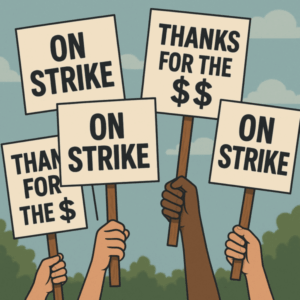
Should business owners be forced to pay their employees to go on strike against them? That’s what could happen if the push to extend unemployment benefits to striking workers becomes national policy.
Progressive Democrats in Congress have introduced legislation to extend unemployment insurance (UI) benefits to workers on strike, following similar measures in several Democratic-led states. Supporters say the proposal would give picketing workers financial stability during labor disputes.
Critics warn it would drive up costs for small businesses, making it harder for them to hire and retain employees.
The idea of paying unemployment benefits to striking workers isn’t new, but the reach of this latest proposal is. Currently, every state except New York and New Jersey denies UI claims from workers who voluntarily go on strike. However, more than 30 states provide benefits to workers who are locked out by management.
Previous efforts to expand UI eligibility to striking workers have largely failed—often for practical reasons rather than political ones. Most strikes in the U.S. last less than a week, according to data from Cornell University and the University of Illinois Urbana-Champaign.
But Democrats in Washington, D.C. and some deep-blue states are still pushing the policy.
In 2018, New Jersey became the first state to guarantee UI for striking workers after 30 days on the picket line—a threshold later reduced to 14 days. New York passed a similar law in 2020.
More recently, Oregon and Washington enacted measures allowing striking workers to collect benefits after 14 days. Democratic supporters said the laws would level the playing field for employees seeking fair pay and benefits.
“This bill ensures workers have the resources they need to effectively bargain with their employers,” said Washington Gov. Bob Ferguson (D).
Not every Democrat agrees. In 2023, California Gov. Gavin Newsom vetoed a bill expanding UI eligibility for striking workers, warning it could raise taxes on employers. California has borrowed about $20 billion from the federal government to cover unemployment payments to jobless residents. Gov. Ned Lamont (D-Conn.) also cited the state’s trust fund when he vetoed a similar bill this past summer.
Many business owners are also strongly opposed.
“Forcing Main Street business owners to fund benefits for striking workers not only leaves small businesses high and dry in a difficult labor market, but it unfairly undermines the integrity of the unemployment system,” writes Tyler Dever of the National Federation of Independent Business (NFIB).
“The same dollars a business owner pays into the unemployment trust fund will be transferred to a striking worker to pay for their protest against their employer. This will lead to higher unemployment insurance taxes, limiting the dollars businesses can use to grow, hire, and invest in their employees.”
Ryan Young, a research assistant at the Competitive Enterprise Institute, told InsideSources the federal proposal is designed to make striking more feasible.
“Unions do have what’s called strike pay, but this would add an extra financial cushion that makes walking off the job easier,” Young said. “The obvious consequence is that strikes would become more frequent.”
Even the left-leaning Seattle Times editorial board warned the measure is “likely to embolden more strikes.”
That hasn’t stopped progressives such as Sen. Adam Schiff (D-Calif.) and Rep. Alexandria Ocasio-Cortez (D-N.Y.) from co-sponsoring the Empowering Striking Workers Act, which would make striking workers eligible for UI benefits after 14 days on the picket line.
They argue the policy would level the playing field between corporations and unions. The bill has the backing of major labor groups including the Teamsters, United Auto Workers, and the AFL-CIO.
Congressional Republicans have countered with the Securing Help for Involuntary Employment Loss and Displacement (SHIELD) Act, which would clarify that workers who are unemployed because of participation in a strike or similar labor dispute are ineligible for regular unemployment compensation.
“It brings balance to the employer-employee relationship and supports small businesses struggling to fill open positions,” Dever said.