
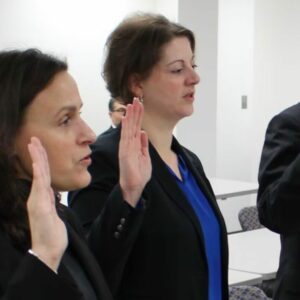
The bail magistrate who reportedly ignored red flags to allow repeat offender Michael Gleason Jr. to walk free before he murdered his wife, Marisol Fuentes, is no longer on the job.
“Stephanie Johnson is not an employee of the New Hampshire Judicial Branch. The branch has two magistrate positions that are currently vacant,” Av Harris, public information officer for the New Hampshire Judicial Branch, told NHJournal Tuesday.
Johnson was one of three magistrates appointed late last year when the position was created. Now, the only bail magistrate still working is Frank Weeks, Harris said.
Executive Councilor John Stephen (R-Manchester) first broke the news on the Jack Heath radio show Tuesday morning.
“I received a message this morning from the court that this magistrate has been released and is no longer employed by the court,” Stephen told the radio host. Later in the day, the councilor issued a statement welcoming Johnson’s exit. Stephen and others wanted Johnson gone over her handling of Gleason’s bail, as well as her mishandling of a Manchester stabbing case months earlier.
“This is just the first step in solving the gaps in our criminal justice system that leave victims vulnerable to further violence,” Stephen said.
Gleason murdered Fuentes on July 6 inside the La Casita Mexican restaurant in Berlin, where she worked. He then took his shotgun into a bathroom and killed himself.
Johnson granted $5,000 cash bail for Gleason, 50, in April when he was charged with sexually assaulting Fuentes, kidnapping her, and stealing her cell phone and $8,000 in cash she was saving. At the time, the Berlin Police wanted Gleason held on bail, but Johnson allowed him to post cash bail instead.
The Internal Review Committee appointed by Chief Justice Gordon MacDonald to investigate the murder found Johnson could have determined, based on the evidence she had, that Gleason was a danger to Fuentes in April and had him held on preventive detention.
“Implicit in the magistrate’s decision was a determination that it had not been shown by clear and convincing evidence that Gleason posed a danger to himself or to the public. The Committee concludes, however, that sufficient evidence existed to hold Gleason in preventive detention,” the report states.
Johnson, Weeks, and Jaye Duncan were appointed as magistrates in December as part of Gov. Chris Sununu’s second attempt at bail reform. The magistrates were supposed to relieve pressure on judges by presiding over bail hearings on nights and weekends.
Gov. Kelly Ayotte pushed for major changes to the bail system once she took office in January, citing repeat, violent offenders getting out of jail thanks to the failed bail reform law. Starting Sept. 21, magistrates will no longer preside over bail hearings under the change Ayotte pushed.
The committee report cites numerous other problems in the way court officials and police officers treated Gleason and Fuentes between April and the July 6 murder. Stephen said that with Johnson gone, it’s time to review the entire system to ensure that victims are protected.
Court officials, judges, lawyers, and police officers all need better training on how to treat domestic violence victims; the courts need better technology to share information in real time so that troubling facts can be communicated; and there needs to be a way to make sure police enforce court orders in domestic violence and stalking cases. Gleason was ordered four times between April and the July murder to hand over his guns and knives, but there is no record from police that ever happened. Above all, Stephen said, there needs to be greater oversight of New Hampshire’s judges.
“We must implement a mechanism outside of the judicial branch to keep them accountable and ensure they’re fulfilling their duties in maintaining the public trust,” Stephen said.
Stephen and Executive Councilor Joe Kenney (R-Wakefield) will meet with Attorney General John Formella, Department of Safety Commissioner Robert Quinn, Police Standards and Training Executive Director John Scippa, and others on Sept. 4 to discuss ways to continue the efforts to protect victims.
“While the failed bail experiment comes to an end, I know that everyone in our state government is committed to further strengthening and improving our systems in order to protect victims and ensure violent offenders aren’t released onto the streets to perpetrate further violence,” Stephen said. “Marisol will not be brought back by the work we are doing—but her legacy will be an incredibly impactful one across the state, and the work this tragedy inspired will save lives.”